
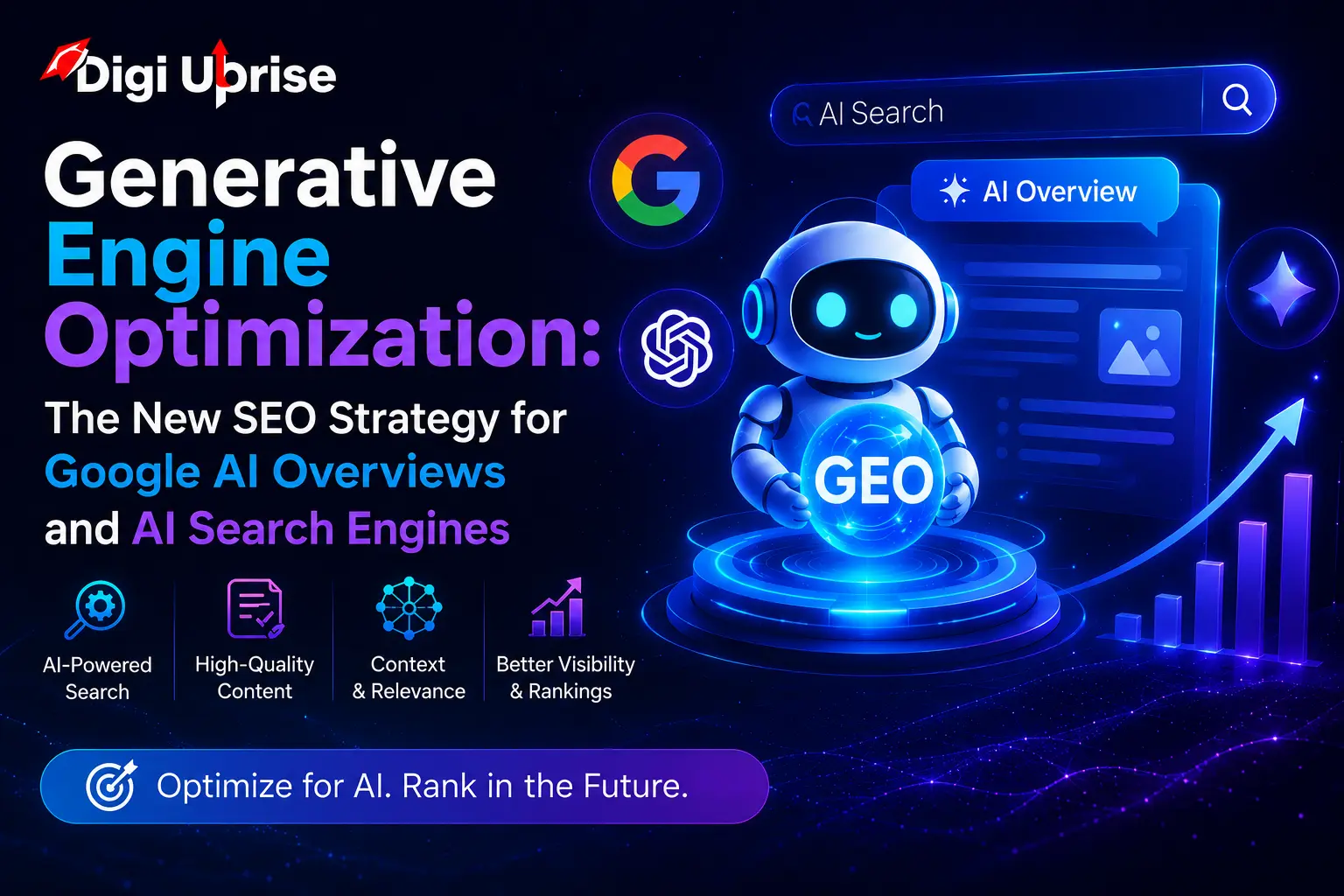
Generative Engine Optimization: The New SEO Strategy for Google AI Overviews and AI Search Engines
Share with Friends :

Table of Contents
- What Is Generative Engine Optimization?
- Key Takeaways
- Why Generative Engine Optimization Matters
- How Generative Engine Optimization Works
- Step-by-Step Approach for Generative Engine Optimization
- Advantages of Generative Engine Optimization
- Mistakes to Avoid
- Expert Insights and Best Practices
- What Is Generative Engine Optimization in Practical Terms?
- Why Is Generative Engine Optimization Important?
- How Does Generative Engine Optimization Work?
- Checklist for GEO Success
- Future Trends in Generative Engine Optimization
- Conclusion
- Frequently Asked Questions
The process that aims at improving understanding and reference capabilities using artificial intelligence-based search engines is termed as Generative Engine Optimization or GEO. This concept finds application especially in cases when the content involved is original and expert-written, along with being well-organized and well-equipped with quality data and explanations. The relevance of GEO is increasing day by day within the current SEO ecosystem because of the role played by search engines such as Perplexity and OpenAI’s newly launched web search engine, both based on generative AI technology.
For brands like Digi Uprise, it is a smart way to build visibility across both traditional search and AI-generated answers.
What Is Generative Engine Optimization?
A content technique called Generative Engine Optimization was created for AI-powered discovery systems that are capable of more than just listing links. These algorithms create a direct response by synthesizing data from several sources rather than just ranking pages. The original GEO paper from Princeton describes it as a framework for improving visibility in generative engine responses, and it reports visibility gains of up to 40% in controlled experiments.
In simple terms, GEO helps your content become the kind of source an AI system wants to quote or paraphrase. That means your page should be easy to scan, rich in useful context, clearly sourced, and genuinely helpful to readers. Google’s own guidance for generative AI search emphasizes unique, valuable, people-first content, strong structure, and avoiding “hacks” that are only meant to manipulate rankings.
Key Takeaways
- The GEO strategy is about visibility of AI-generated content, rather than its ranking on blue-links.
- The AI engine loves unique, credible, and easy-to-read content.
- Good use of headings, clear definitions, and logical organization increase the readability by machines.
- Personal opinion counts higher than mere summarization.
- The GEO strategy is highly dependent on the SEO basics, technical excellence, and great page experience.
- Earned authority, citations, and entity clarity help AI systems trust your content. This is an inference from how source-backed answer engines work.
- In AI search, “more pages” is not a strategy; better answers are.
Why Generative Engine Optimization Matters
The way individuals find information is being altered by AI search. Instead of scrolling through ten links, users increasingly get a synthesized answer with citations or source references. While Perplexity presents itself as an answer engine with real-time results and citations, OpenAI’s web search and deep research capabilities specifically deliver cited answers. That means your content must be built to be referenced, not just discovered.
GEO is important for businesses since it influences brand visibility during the decision-making process. If your page is clear, trustworthy, and relevant, it has a better chance of being used as a supporting source in an AI answer. For publishers and marketers, this is the new version of “page one”: being present inside the answer itself.
How Generative Engine Optimization Works
GEO works by making your content easier for AI systems to parse, evaluate, and cite. These systems typically break a query into sub-questions, scan multiple sources, and synthesize a response. That means pages with clear headings, entity-rich language, direct answers, and strong supporting context are more likely to be used. Google’s generative AI guidance highlights unique viewpoints, clear organization, and useful media as signals that help content stand out.
The GEO Signal Stack
Signal | Why it helps AI search | Example |
Clear definition | Easy for models to quote | Content optimization for AI-generated responses is known as GEO. |
Original insight | Differentiates from generic pages | A real case study from your brand |
Strong structure | Improves extraction | H2s, bullets, FAQs, tables |
Entity clarity | Helps systems understand topic relevance | Mention related tools, methods, and organizations |
Trust signals | Increases credibility | Author bio, sources, evidence, update dates |
Step-by-Step Approach for Generative Engine Optimization
1. Begin with a user question
Pinpoint the exact question your audience seeks to answer. The AI system prefers full-fledged answers on topics over pages that seek to game various keyword permutations. Google’s advice discourages the creation of several near-duplicate pages.
2. Write a direct definition at the start
Place an explanation in the first 100 words of your page to benefit both the users and the AI systems. Definition pages increase the likelihood of getting cited by AI in answer boxes.
3. Use semantic depth
Use other entities or concepts in your page like SEO, E-E-A-T, structure, crawlability, content authority, topical maps, and answer engines. Under Search Essentials, Google recommends using natural language, placing these keywords in parts that are highly visible, and providing clear supporting information.
4. Ensure that the page scans well
Short paragraphs, informative headlines, bulleted lists, and tables all help. The generative AI guidelines from Google mention that well-organized content will make the content easier to use and understand.
5. Back up with supporting evidence
Include actual case studies, screenshots, test data, or implementation details. The people-first content guidelines from Google ask if the content backs itself up with first-hand knowledge and depth. This is the exact sort of validation that can be trusted by an AI system.
6. Help out with some SEO
Keep your site crawlable, use appropriate title tags, and link to important pages internally. The Search Essentials guide from Google is still valuable because the generative models are based on the very same indexing principles.
7. Update for accuracy, not appearance
Ensure that your content stays accurate with changes in the facts, but not necessarily for updates just because it needs to appear new. Google explicitly warns against date changes and unnecessary content mass-ups.
Advantages of Generative Engine Optimization
- Greater presence in AI-based results: Content can be used in summarization and not disregarded in favor of your competitors.
- Increased credibility: Well-sourced and well-framed information will be perceived as more credible.
- User satisfaction: A well-organized page with informational content will better meet a user’s needs in less time.
- Greater efficiency in content repurposing: Definitions, bulleted lists, and examples will be more efficiently extracted by AI technologies. That is my assumption, based on how answer engines create their summaries.
- Positioning for the future: GEO corresponds with the trends in the search industry that emphasize answers more.
Mistakes to Avoid
AI-wrapped thin content
This kind of content is poor both from an SEO and GEO point of view. According to Google, avoid copying content from the internet unless you add some fresh ideas into it.
Keyword stuffing
Use of keywords such as “generative engine optimization” too many times leads to unnatural texts. According to Google, you should produce high-quality pages for users.
Lack of content organization
AI prefers structuring texts through headers and separating paragraphs into distinct sections. As per Google advice, you should have clear and logical structure in your texts.
Over-chasing keyword variants
Creation of different pages based on rare keywords can be ineffective. Google warns against page indexing of high quantity but bad quality pages.
Expert Insights and Best Practices
A strong GEO strategy blends editorial quality with technical discipline. The best-performing content usually has a clear author identity, a distinct point of view, clean formatting, and helpful proof. For brands like Digi Uprise, this means creating content that reflects real campaign experience, practical frameworks, and measurable lessons instead of generic advice. That is the sort of material AI systems can recognize as more useful than commodity content.
One advanced tactic is to build “answer-ready” blocks throughout your article: short definitions, numbered steps, mini-comparisons, and FAQ-style explanations. Another is to reinforce entity relationships through consistent terminology, such as linking GEO with SEO, structured data, E-E-A-T, topical authority, and AI search visibility. These methods improve both comprehension and citation potential.
What Is Generative Engine Optimization in Practical Terms?
Generative Engine Optimization is the discipline of making content usable by AI answer systems. Instead of only trying to win rankings, GEO helps your page become the source that a model selects, cites, or paraphrases. That makes it a bridge between classic SEO and the new generation of answer engines.
Why Is Generative Engine Optimization Important?
GEO is important because AI search results often answer the user immediately. If your content is not structured for extraction and trust, it may never appear in the answer layer even if it ranks well traditionally. Google’s own guidance now treats people-first quality as central to visibility in generative AI search.
How Does Generative Engine Optimization Work?
GEO works by improving the signals AI systems use to choose sources: clarity, originality, structure, trust, and relevance. The better your content explains a topic, supports its claims, and stays easy to scan, the more likely it is to be cited or summarized by an AI engine.
Checklist for GEO Success
- Write a direct definition near the top.
- Add clear H2 and H3 sections.
- Include one comparison table.
- Use examples and first-hand experience.
- Mention related entities naturally.
- Keep paragraphs short.
- Add FAQs that answer real search questions.
- Strengthen internal links and crawlability.
- Avoid repetitive, low-value content.
- Update only when the page becomes more useful.
Future Trends in Generative Engine Optimization
GEO will likely become more important as search experiences move toward direct answers, multimodal results, and agentic browsing. Google has already published guidance focused on generative AI search, and it also points to emerging agent-friendly website practices and protocols. OpenAI and Perplexity continue to build systems that rely on citations and fresh sources, which means content quality, source credibility, and machine readability will matter even more.
Expect a bigger emphasis on unique expertise, source transparency, and content that answers questions in a format AI can reuse cleanly. In practice, that means brands that invest in original research, case studies, and strong editorial standards will have an advantage. The winners will not be the loudest publishers; they will be the most useful ones.
Conclusion
Generative Engine Optimization (GEO) has become an indispensable aspect of content strategy for today’s business environment. The most successful GEO pages are anything but gimmicks, keyword-loaded, and solely optimized for bots. They are useful, creative, structured properly, and based on solid expertise. This explains why SEO and GEO go hand in hand nowadays.
For content marketers, content producers, and digital agencies, like Digi Uprise, the key to success is to develop content people can rely on, and the machines will be less likely to doubt it. With time, the future of generative search will prove that pages which speak clearly, provide in-depth explanations, and give true value will prevail. Follow Digi Uprise on Instagram to learn about the trends, developments, successes, and valuable education related to the future shifts in search technologies.
Frequently Asked Questions
1. Is Generative Engine Optimization the same as SEO?
Of course not! While SEO is all about ranking in the search engine, GEO focuses on the way that the content is presented in the AI-generated answer layer. Many things connect the two terms as quality, structure, and relevance still matter. It is also worth mentioning that Google documents emphasize that people-focused SEO is also relevant to GEO.
2. If I am doing SEO, do I need GEO?
Certainly! Consumer behavior was changed due to AI answer layers, and your website could be ranked quite high according to SEO, but the answer engine could ignore it because of poor format and lack of credibility.
3. What type of content does best in GEO?
The kind of content that works best in GEO would be content that is unique, practical, well-structured, and based on actual expertise. The guidelines by Google emphasize uniqueness, non-commoditization, and structure as key factors of generative AI search success.
4. Are there any particular keywords needed for GEO?
No need for special keywords but better use of the language. You should use words that people would normally use while searching for the topic you are writing about and put those keywords in the title and headings. This will allow you to cover related entities as well.
5. Can content created by AI compete with GEO?
Certainly, however, this will be possible only when such content has substance, accuracy, and quality editing behind it. As far as Google says, it is not about how it was created; what is important is that the end result should be useful and people-focused.