

- September 1, 2026
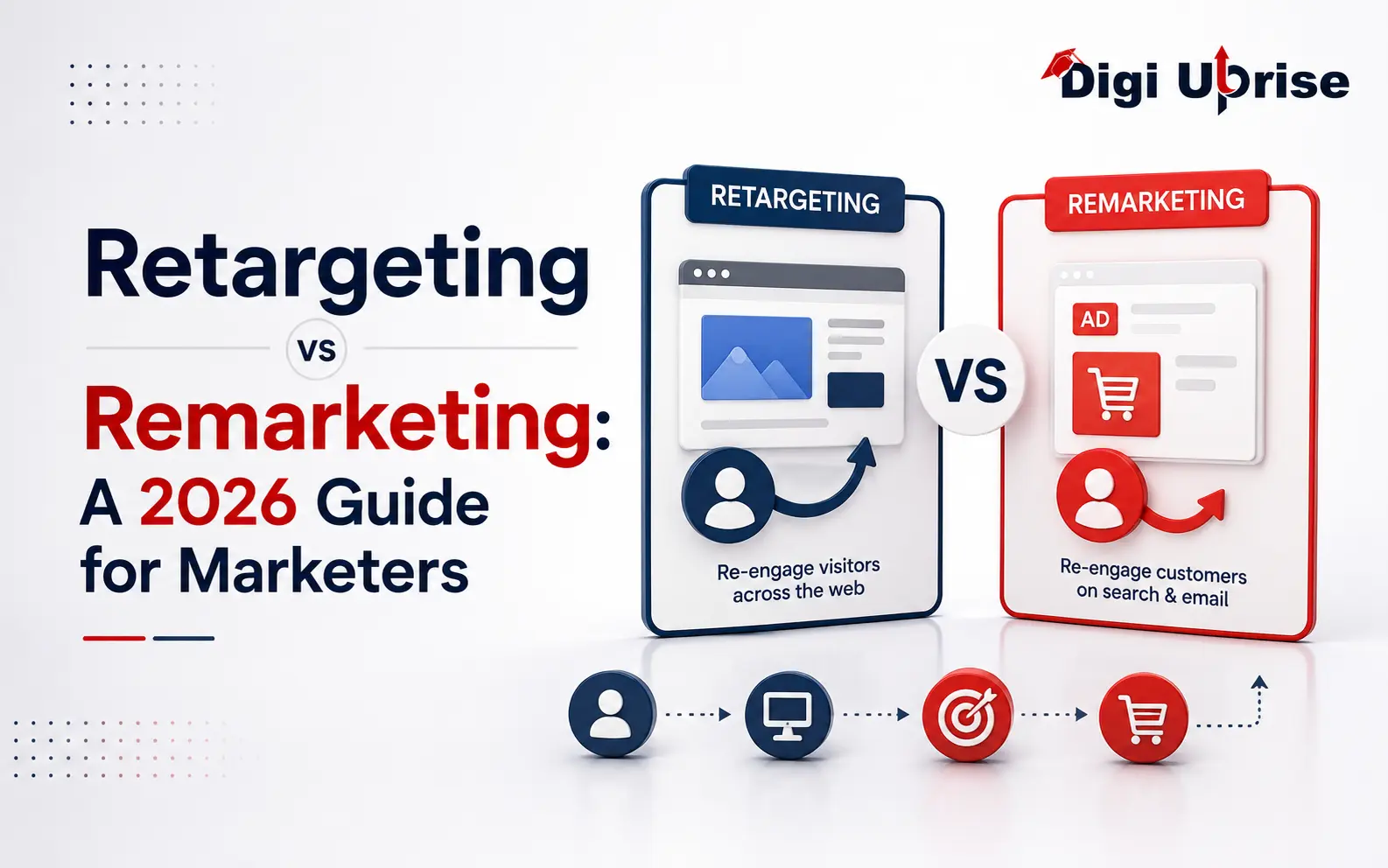
Retargeting vs Remarketing: A 2026 Guide for Marketers
Share with Friends :

Table of Contents
Think of a situation where a person goes shopping online, browses a few items, and exits without making a purchase. After a couple of days, the individual comes across an ad for these particular items on their Facebook timeline.
These are common examples of retargeting and remarketing. Even though the two terms tend to be used interchangeably, there’s actually a significant difference between them in relation to methods of reconnecting with prospects.
In this guide, we’ll break down the difference between remarketing and retargeting, explain when each strategy works best, and look at how both are changing as marketers adapt to a more privacy-focused digital environment.
What Are Retargeting and Remarketing?
Not every website visitor becomes a customer on their first visit. People may browse products, compare services, read reviews, or leave because they are not ready to make a decision.
Retargeting and remarketing help businesses reconnect with these people instead of starting the customer journey from scratch.
What is retargeting?
Retargeting is a digital advertising technique used to reach people who have previously interacted with a website, app, or brand.
For example, a person browses an online store that sells shoes, views a certain type of shoe, and then leaves the store without making any purchase. Some time later, while using another website or social networking site, the person sees an ad for that particular shoe.
The purpose is to remind the visitor about the brand and encourage them to return.
What is remarketing?
Remarketing is the process of reconnecting with people who have already interacted with a business. It can include paid advertising, email, customer communication, and other marketing channels.
For example, a shopper adds a product to their cart but doesn’t complete the purchase. The business can send a reminder email encouraging them to return.
Remarketing can also be used with existing customers to promote related products, new services, or future offers.
Retargeting vs Remarketing: What's the Difference?
The terms retargeting and remarketing are often used interchangeably, which can make the difference difficult to understand.
Traditionally, retargeting has been associated with paid advertisements shown to previous website visitors. Remarketing has often been associated with email campaigns and communication with existing leads or customers.
Retargeting | Remarketing |
Mainly associated with paid advertising | Can include email and other channels |
Often targets previous website visitors | Can target leads and existing customers |
Focuses on bringing users back | Can focus on re-engagement and retention |
Common in PPC and social advertising | Common in email and customer marketing |
However, this distinction is not universal. Google Ads uses the term “remarketing” for advertising campaigns that reach people who have previously interacted with a business.
Therefore, the important thing is not the terminology but the audience, objective, message, and marketing channel being used.
How Does Retargeting Work?
Retargeting begins when someone interacts with a website, app, or other digital property.
Based on the advertising network, privacy settings, permission, and information about audiences that is available, eligible individuals can become part of an audience.
Businesses are able to advertise to the appropriate individuals.
A basic consumer journey could follow this pattern:
Search → Website Visit → Product View → Leave → Retargeting Ad→ Return → Conversion
In the case where a person is searching for a digital marketing course and lands on the course page, he/she views the syllabus but does not make an inquiry.
If they are part of an eligible advertising audience, the business may later show them an advertisement related to the course.
What can trigger retargeting?
Businesses may create audiences based on actions such as:
- Visiting a product or service page
- Viewing multiple pages
- Adding an item to a cart
- Starting a form
- Downloading a resource
- Interacting with specific website content
This makes it possible to create more relevant advertising instead of showing one generic message to every visitor.
How Can Businesses Use Remarketing?
Remarketing can be used throughout the customer journey. The most effective approach is to match the message with the user’s previous interaction.
Ecommerce remarketing
A customer adds a pair of gloves to their cart but leaves without completing the purchase.
The business can send an abandoned-cart email or show an appropriate reminder through advertising.
Service-based businesses
Someone visits a company’s SEO service page but doesn’t submit an enquiry.
A later campaign could highlight the service’s benefits, customer results, testimonials, or helpful educational content.
Existing customers
A customer purchases a camera.
The business can later recommend a compatible tripod, memory card, lens, or camera bag.
This type of remarketing focuses on repeat purchases rather than acquiring a completely new customer.
Education businesses
Someone visits a digital marketing course page but does not enroll.
A training business can reconnect with that person using useful information about course modules, practical learning, career opportunities, or upcoming batches.
The objective should not simply be to show the same advertisement repeatedly. The message should give the person a relevant reason to return.
How to Create an Effective Retargeting Campaign?
An efficient retargeting strategy begins with understanding the target audience and their intentions.
Define the objective
Initially, you need to define the desired actions on the part of users.
- Complete a purchase
- Submitting a query
- Book a consultation
- Register for a course
- Downloading a document
- Return to the website
- Make another purchase
A clear objective makes it easier to choose the right audience and measure results.
Segment your audience
Not all visitors have the same level of interest.
Someone who viewed a homepage for a few seconds should not necessarily receive the same message as someone who added a product to their cart.
Useful audience groups can include product viewers, service-page visitors, cart abandoners, leads, and previous customers.
Create relevant messages
Your advertisement should reflect the user’s previous action.
For example, a person who viewed a specific product could receive an ad about that product rather than a general brand advertisement.
Match the landing page
The landing page should support the advertisement.
If the ad promotes a particular product, take users directly to that product page. If it promotes a course, the landing page should clearly explain the course and its benefits.
A relevant landing page can make the transition from advertisement to conversion much smoother.
Control frequency
Showing the same advertisement too often can lead to ad fatigue.
Use different creatives, headlines, and formats where appropriate. Also consider excluding users after they complete the desired action.
Common Mistakes and Key Metrics
Even a well-planned campaign can underperform if marketers ignore basic mistakes or measure the wrong things in retargeting and remarketing.
Common mistakes
- Targeting every visitor with the same message
- Showing ads too frequently
- Using outdated creative
- Continuing ads after conversion
- Sending users to irrelevant landing pages
- Ignoring privacy and advertising platform requirements
Important metrics
| Metric | Purpose |
| CTR | Measures ad engagement |
| Conversion Rate | Measures completed actions |
| Cost per Conversion | Measures acquisition efficiency |
| ROAS | Compares revenue with ad spend |
| Frequency | Shows how often ads are displayed |
A campaign should not be judged only by clicks. The real question is whether those clicks lead to enquiries, purchases, registrations, or another meaningful business result.
Conclusion
Retargeting and remarketing help businesses reconnect with people who have already shown interest. Instead of constantly searching for new audiences, brands can continue engaging potential and existing customers.
The key is to understand user behaviour, create relevant audience segments, use useful messaging, and measure results regularly.
Digi Uprise helps learners understand practical digital marketing concepts such as paid advertising, audience targeting, and campaign optimization.
Follow Digi Uprise on Instagram and YouTube for more digital marketing insights and practical learning resources.
Frequently Asked Questions
1. Is retargeting and remarketing the same thing?
Both are very similar, but while retargeting is associated with paid advertisements, remarketing involves various types of communication like emails.
2. Is retargeting useful for small businesses?
Yes. Small businesses can use retargeting to reconnect with interested website visitors, provided they have enough relevant traffic and a clear campaign objective.
3. How long should retargeting campaigns run?
This depends on several factors, including the nature of the product being marketed, the buying process of the consumers, and more.
4. Can remarketing help increase repeat purchases?
It is possible for organizations to use the technique of remarketing to market other related products and services that may appeal to former consumers.
5. Can retargeting be used on social media?
Yes, organizations can use social media to retarget consumers through social advertising platforms.