

- September 2, 2026
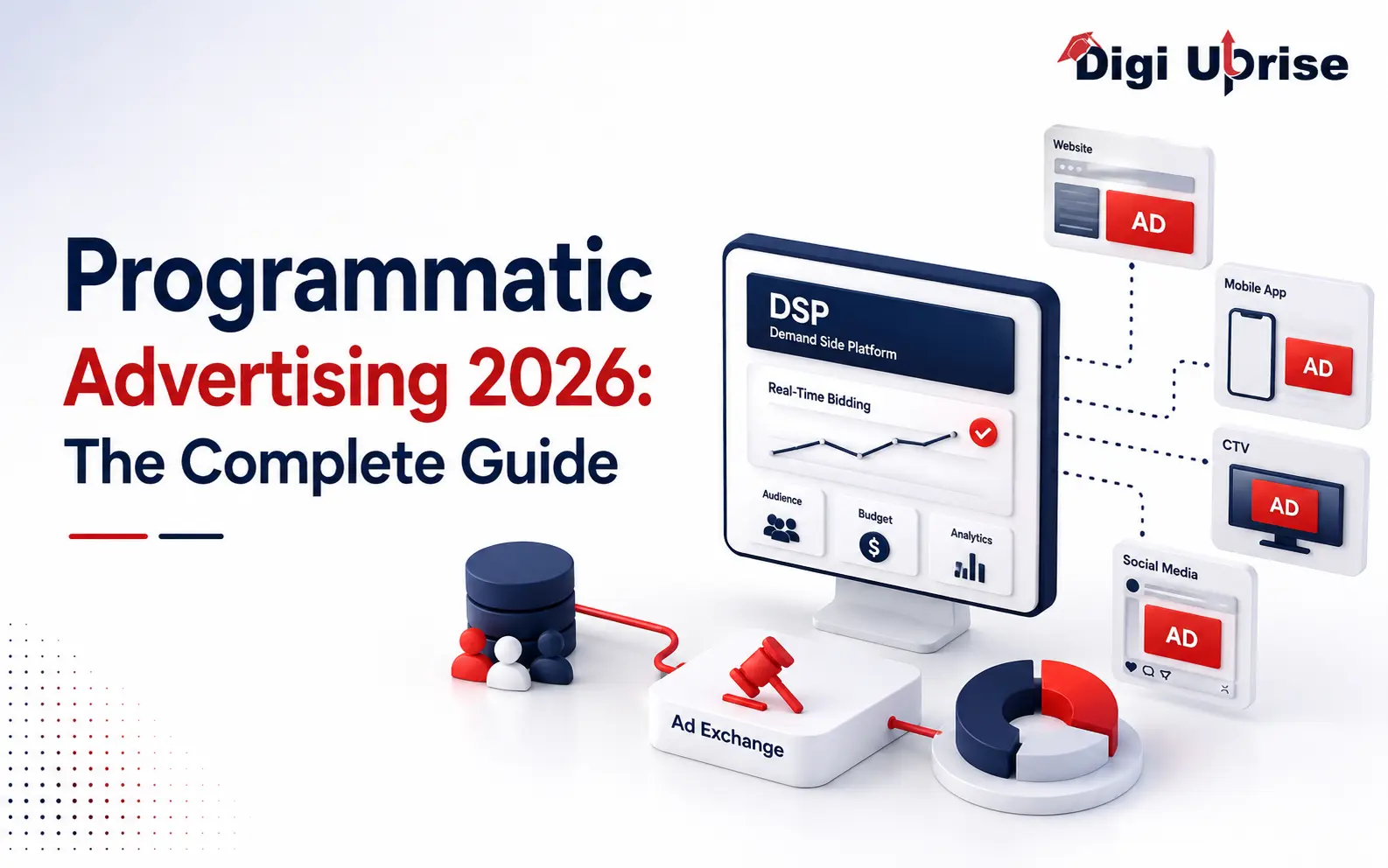
Programmatic Advertising 2026: The Complete Guide
Share with Friends :

Table of Contents
- What Is Programmatic Advertising?
- How Does Programmatic Advertising Work?
- What Are the Main Types of Programmatic Advertising?
- What Are the Benefits of Programmatic Advertising?
- What Are the Challenges of Programmatic Advertising?
- How Can You Create a Better Programmatic Campaign?
- Conclusion
- Frequently Asked Questions
Have you ever noticed an ad for something you recently searched for appearing on another website? That is often where programmatic advertising comes into play.
But what is programmatic advertising, and how does automated ad buying actually work?
This guide from Digi Uprise explains how programmatic ads work, their major types, key benefits, challenges, and practical examples for beginners.
What Is Programmatic Advertising?
Programmatic advertising refers to the automated method of acquiring and selling digital advertising slots by using software and algorithms. This means that advertisers do not need to negotiate with publishers each time they have to acquire advertising slots.
In simple terms, programmatic ads help businesses deliver advertisements to the right audience, at the right time, and in the right digital environment.
For example, imagine an online fashion brand promoting winter jackets. Instead of showing the same advertisement to everyone, the brand can use audience data and targeting signals to reach people who have recently searched for winter clothing or visited fashion-related websites.
Programmatic advertising vs traditional ad buying
| Traditional Ad Buying | Programmatic Advertising |
| More manual processes | Automated buying |
| Takes more time | Works in real time |
| Limited targeting | Advanced targeting |
| Manual optimization | Algorithm-based optimization |
| Direct negotiations | Automated platforms |
The biggest difference is automation. Technology handles much of the buying process, allowing marketers to spend more time on strategy, creative development, and campaign analysis.
How Does Programmatic Advertising Work?
The programmatic buying process can involve several platforms and technologies, but the basic concept is relatively simple.
When someone visits a website or app with advertising space, an automated process can begin almost instantly.
The programmatic advertising process
1. A user visits a website or app
An advertising impression becomes available.
2. The impression enters an ad marketplace
Information about the available advertising opportunity is processed through an automated system.
3. Advertisers compete for the impression
Advertisers whose targeting requirements match the opportunity can participate in the buying process.
4. The system evaluates the bids
Factors such as bids, campaign settings, targeting, and inventory requirements are considered.
5. The winning ad is displayed
The selected advertisement is delivered to the user, often within milliseconds.
For example, suppose someone searches for hotels in Goa and later visits a travel website. A hotel company running a relevant campaign may compete for that impression. If the visitor matches the campaign’s targeting criteria, the hotel’s advertisement could appear.
This happens extremely quickly, often before the webpage has completely loaded.
What Are the Main Types of Programmatic Advertising?
It involves several technologies and platforms that work together to automate digital ad buying. The main components include DSPs, SSPs, DMPs, ad exchanges, and ad networks.
Demand-Side Platform
Advertisers and agencies use a demand-side platform (DSP) for automated purchase of digital ad space. It helps advertisers select target audiences and set budgets.
Supply-Side Platform
Publishers use a Supply-Side Platform (SSP) to sell their available advertising space automatically. It helps publishers connect their inventory with multiple advertisers and maximize the value of their ad space.
Data Management Platform
A Data Management Platform (DMP) gathers and sorts audience data from various sources. This data can be used by marketers to form audience segments that would be suitable for advertising campaigns.
Ad Exchange
An ad exchange is an online auction site where advertisers and publishers meet to buy and sell advertising space. It allows for linking up the advertiser’s demand with the publisher’s supply.
Ad Network
The ad network gathers the advertising space provided by various publishers and sells it to advertisers. Ad networks make it possible for companies to address a wider audience while negotiating with each publisher individually.
What Are the Benefits of Programmatic Advertising?
The growing popularity of programmatic ads is largely driven by automation, audience targeting, scalability, and real-time campaign management.
Some of its key benefits include:
- Better audience targeting: Advertisers can target users based on relevant characteristics, interests, behaviors, and other signals.
- Greater scalability: Campaigns can reach audiences across numerous websites, apps, and digital environments.
- Faster ad placement: Automated systems cut down the time spent on negotiations.
- Real-time optimization: The parameters of the campaign can be adjusted depending on its performance.
- Budget control: Advertisers can establish spending limits and bidding strategies.
- Data-driven decisions: Campaign data can help marketers understand which audiences and creatives perform best.
These benefits make programmatic buying useful for both brand awareness and performance marketing campaigns.
However, automation does not guarantee success. A strong strategy, relevant audience, compelling creative, and proper measurement are still necessary.
A practical example
Imagine a digital marketing institute wants to promote a new course.
Rather than displaying its ads randomly, the institute could target people interested in:
- Digital marketing
- SEO
- Google Ads
- Social media
- Online education
- Career development
The campaign can then monitor clicks, conversions, cost, and other performance indicators. Based on the results, the advertiser can adjust its audience, creative, or bidding strategy.
This allows marketers to use their budget more efficiently while reaching potentially relevant users.
What Are the Challenges of Programmatic Advertising?
Although programmatic ads provide many advantages, businesses should also understand their challenges.
Ad fraud
Bots and invalid traffic can create false impressions or clicks, which may lead to wasted advertising budgets. Working with trusted platforms and checking the quality of your campaign will allow you to minimize the risk.
Brand safety
The ad may be placed in an environment that doesn’t match the values of the organization. Advertisers can use brand-safety options to manage this problem.
Data privacy
There may be user data involved in the process of programmatic advertising; therefore, privacy issues may arise.
Technical complexity
The programmatic ecosystem includes different technologies, such as demand-side platforms, supply-side platforms, ad exchanges, and other tools. Understanding how these systems work together can take time.
Viewability
An impression does not necessarily mean that a user actually noticed an advertisement. Advertisers should consider viewability and other quality metrics rather than focusing only on impression volume.
The most effective approach is to combine automation with human oversight. Technology can make decisions quickly, but marketers still need to monitor performance, quality, and brand safety.
How Can You Create a Better Programmatic Campaign?
Knowing how programmatic ads work is only the beginning. Businesses also need a clear strategy to achieve meaningful results.
Define your campaign objective
Start by deciding what the campaign needs to accomplish. Common objectives include:
- Brand awareness
- Website traffic
- Lead generation
- Product sales
- App installs
- Retargeting
Your objective should determine how you measure success.
Identify the right audience
Avoid trying to reach everyone. Define your audience based on relevant interests, behaviors, demographics, context, or appropriate first-party data.
Create effective ad creatives
Strong targeting cannot compensate for poor creative. Your advertisement should communicate its main message quickly and give users a clear reason to take action.
Track important metrics
| Campaign Objective | Useful Metrics |
| Brand Awareness | Reach, impressions, viewability |
| Website Traffic | CTR, sessions |
| Lead Generation | CPL, conversion rate |
| Sales | CPA, ROAS, revenue |
| Video Campaigns | Completion rate, viewability |
Test and optimize
Try out different creatives, audience groups, ad placements, and bidding mechanisms where necessary. Analyze the performance frequently, and direct your budget to those that are giving good results.
A programmatic campaign should not simply be launched and forgotten. Continuous monitoring and optimization can improve efficiency over time.
Conclusion
Programmatic advertising has revolutionized the way digital advertisements are bought, making the process efficient, automated, and data-driven. Depending on the objective of the advertiser, there are a number of ways that advertisers can go about their advertising business.
Through Digi Uprise, the students can learn practical knowledge related to digital marketing. The courses provided by Digi Uprise include SEO, Google Ads, Meta Ads, social media marketing, and AI-based marketing.
Follow Digi Uprise on Instagram and YouTube for digital marketing tips, strategies, and learning resources.
Frequently Asked Questions
1. Is programmatic ads suitable for small businesses?
Yes. Small businesses can use programmatic ads if the available platform, budget, audience, and campaign goals make it practical. Starting with a focused audience and measurable objective can make testing easier.
2. What platforms are used for programmatic ads?
Demand-side platforms (DSPs) are popular tools for running programmatic ads. Depending on the DSP, there will be varying types of inventory, targeting, data, and optimization offered.
3. Do programmatic ads work for B2B companies?
Yes. Programmatic advertising is effective for B2B firms that can leverage this type of advertising in order to reach professional audiences, create brand awareness, and generate leads.
4. What is programmatic video advertising?
This refers to the use of automated technology for buying video ad inventory on suitable digital media, which may also include online videos.
5. How are programmatic ads measured?
Campaign performance can be measured using metrics such as impressions, reach, CTR, viewability, conversions, CPA, CPL, revenue, and ROAS. The most relevant metrics depend on the campaign’s primary objective.