

- September 4, 2026
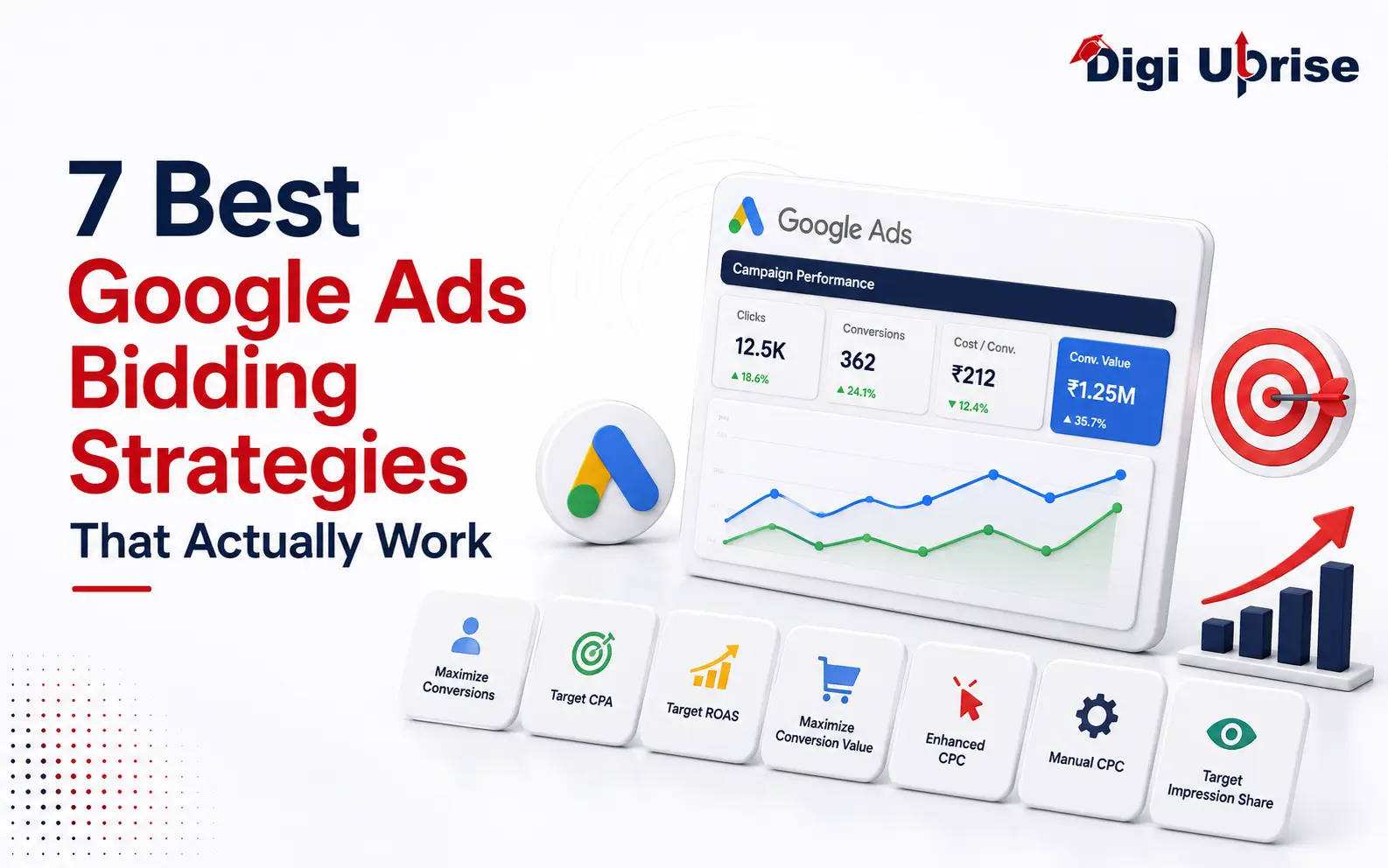
7 Best Google Ads Bidding Strategies That Actually Work
Share with Friends :

Table of Contents
If you’ve sat in front of your Google Ads interface and wondered why your clicks are not generating any more leads for you, then you are not the only one. Your choice of bidding strategy will play an important role in deciding what kind of results your budget can generate for you.
This guide walks through the major Google Ads bidding strategies, how each one actually works, when it makes sense to use it, and the mistakes that trip up even experienced advertisers.
Understanding Google Ads Bidding Strategies
At its core, Google Ads bidding strategies are how Google decides to spend your budget during ad auctions. Rather than manually setting a price for every single search, you tell Google what outcome you care about, and it works toward that.
Maybe you want:
- More website visits
- More leads
- More sales
- Lower acquisition costs
- Better return on ad spend
- More visibility for certain searches
Once you know your goal, the bidding strategy should follow from it. Not the other way around.
Why Does This Actually Matter?
Picture an online education company spending ₹60,000 a month on ads. If all they care about is traffic, they’d chase cheap clicks wherever they can find them. But if what they really need is student enquiries, cheap clicks alone won’t cut it. They might just be paying for a lot of window shoppers.
The conversion-driven approach steers Google towards auctions in which it is more probable that there will be completion of that form. This is how the strategy affects Google’s choices: it does not just represent one of the settings but the process determining what type of results you will have.
So don’t pick a strategy because it sounds fancy or “AI-powered.” Pick it because it matches what you’re actually trying to achieve.
7 Google Ads Bidding Strategies Worth Knowing
There’s no universal “best” strategy here. It depends on your goal, how much conversion data you have, your budget, and how your business makes money.
1. Maximize Clicks
This one does exactly what it says: it tries to get you as many clicks as your budget allows.
It works well for newer websites still building traffic, or for campaigns where the main goal is simply getting more eyes on the site. A new site publishing marketing guides, for instance, might lean on Maximize Clicks to get people reading.
Just keep in mind, lots of clicks don’t automatically mean lots of customers. Traffic is a means, not an end.
2. Maximize Conversions
Here, the goal shifts from clicks to conversions: a form fill, a phone call, a booking, a purchase, whatever you’ve defined as valuable.
Say a digital marketing institute wants more course enquiries. Instead of optimizing for visits, they’d point the campaign at completed enquiry forms instead. Makes sense, right?
The catch is that this strategy leans hard on your conversion tracking. If your tracking is off, Google will happily optimize for the wrong thing.
3. Target CPA
CPA stands for Cost Per Action. Essentially, what you’re willing to pay to get one conversion.
If a business knows it can comfortably spend ₹600 per qualified lead, that becomes the target once there’s enough historical data to work from. Set the number too aggressively low, though, and you’ll choke off the very auctions that could bring you leads.
4. Target ROAS
Return on Ad Spend is for businesses where not all conversions are created equal.
Think of an online store selling everything from ₹1,000 to ₹15,000 products. A ₹10,000 sale obviously matters more than a ₹1,000 one, even though both count as “one conversion” on paper. Target ROAS lets you optimize around actual revenue instead of just conversion count.
5. Maximize Conversion Value
Similar idea, different angle. This type of Google Ads bidding strategy tries to squeeze the most total value out of your budget, which is especially useful for e-commerce stores with a wide price range.
Purchase | Conversion Value |
Product A | ₹1,000 |
Product B | ₹3,500 |
Product C | ₹8,000 |
Product D | ₹12,000 |
Instead of treating every sale the same, this approach recognises that some purchases are worth chasing harder than others. Sometimes the win isn’t the highest number of conversions. It’s the highest-quality revenue.
6. Target Impression Share
Sometimes visibility matters more than immediate conversions. That’s what these Google Ads bidding strategies are for.
A well-known brand, for example, might want to own the top spot whenever someone searches its name, partly for visibility, and partly to keep competitors from swooping in on branded searches.
7. Manual CPC
This is the classic method. You bid manually, keyword by keyword, without the help of Google’s automated processes.
It may have a use: for testing, strict budget control, and unorthodox campaigns. However, for many firms with sufficient conversion statistics, it has been superseded by automated Google Ads bidding strategies for a good reason.
How to Choose the Right Google Ads Bidding Strategy
Here’s a quick way to map goal to strategy:
| Primary Goal | Strategy to Consider |
| Increase website traffic | Maximize Clicks |
| Generate more leads | Maximize Conversions |
| Maintain acquisition efficiency | Target CPA |
| Improve revenue efficiency | Target ROAS |
| Increase sales value | Maximize Conversion Value |
| Improve search visibility | Target Impression Share |
| Maintain direct bid control | Manual CPC |
Start With the Goal, Not the Setting
Even before you tinker with your bids, take a step back and ask yourself what the campaign is supposed to deliver. Browsers? Leads? Sales? This should be the deciding factor behind any Google Ads bidding strategy you pick.
Check Your Conversion Tracking First
Automated bidding is only as smart as the data feeding it. If an online store mistakenly counts every product-page visit as a purchase, Google will start optimizing for browsers, not buyers.
Before flipping the switch on automation, it’s worth double-checking:
- What you’re counting as a primary conversion
- Whether conversion values are set up correctly
- Your attribution settings
- Whether tracking is actually firing correctly
- Lead quality
- Purchase data accuracy
Get this right, and everything downstream gets easier.
Don’t Change Everything at Once
A temptation is to undertake a whole renovation at once: a different bidding strategy, a different landing page, different keywords, and a different budget altogether. However, when performance changes subsequently, good luck determining what really caused it; make only one meaningful change at a time when possible.
Set Realistic Targets
If your campaign historically brought you leads with a cost per action (CPA) of ₹800, lowering the target to ₹200 is anything but ambitious. It is rather unrealistic. You will be missing out on the opportunities to bid on auctions you could have won. The same applies to unrealistically high return on ad spend (ROAS) targets.
Beyond Bidding: What Else Moves the Needle
A bidding strategy is one part of the equation and by no means a complete one. Relevant keywords, compelling ad copy, conversion-oriented landing pages, proper tracking, and regular reviews are essential for a winning campaign as well.
Here’s a quick checklist to go over:
- Define the main campaign objective
- Determine the actual meaning of conversion for your business
- Confirm tracking is working properly
- Choose a bidding strategy that fits the objective
- Establish realistic CPA/ROAS goals
- Give results time before judging them
- Test changes one at a time
- Look at lead or customer quality, not just volume
And the last point is way more important than people may think. In the case of a real estate company, for instance, 100 form fills per month look like a good number, until you understand that only five of those were really qualified leads.
Let the Data Talk Before You Panic
Daily numbers fluctuate for many reasons: competition, seasonality, demand, budget pacing- take your pick. One bad day doesn’t necessarily mean that you have a bad strategy.
- Conversion volume
- Cost per conversion
- Conversion value
- ROAS
- Search impression share
- Lead quality
Once you’ve got enough data, compare it against what you originally set out to achieve. Then decide what, if anything, needs to change.
Conclusion
There is no doubt that the perfect Google Ads bidding strategy is not always the latest or the most “automated” one of the bunch. The perfect bidding strategy is the one that will work for you.
Digi Uprise helps learners build practical digital marketing skills, including the kind of paid advertising know-how you can put to work on real campaigns right away.
Follow Digi Uprise on Instagram for bite-sized digital marketing tips, and check out the YouTube channel for deeper learning and industry insights.
Frequently Asked Questions
1. Which Google Ads bidding strategy is best for beginners?
Focus first on defining your goal and setting up conversions. A traffic-oriented campaign and a lead generation campaign require entirely different Google Ads bidding strategy.
2. What bidding strategy should I use for lead generation?
A conversion-focused Google Ads bidding strategy tends to work well once you have reliable lead tracking and enough data to work with. Just make sure you’re also weighing lead quality and value, not only quantity.
3. What's the difference between CPC and CPA bidding?
CPC is about what you pay per click. CPA is about what it costs to get an actual conversion. They’re two different Google Ads bidding strategies optimizing for different outcomes entirely.
4. Does increasing the Google Ads budget improve results?
It may be, however, only if all other elements – including your targeting, monitoring, advertising, and landing pages – are doing their job properly. If not, an increase in budget will be pointless.
5. Can Google Ads bidding strategies improve ROI?
Yes, they can be if they are right for your marketing goal and your conversion data is reliable. Otherwise, bidding alone won’t save you from poorly chosen keywords, bad advertisements, ineffective landing pages, or faulty monitoring.