

- September 24, 2026
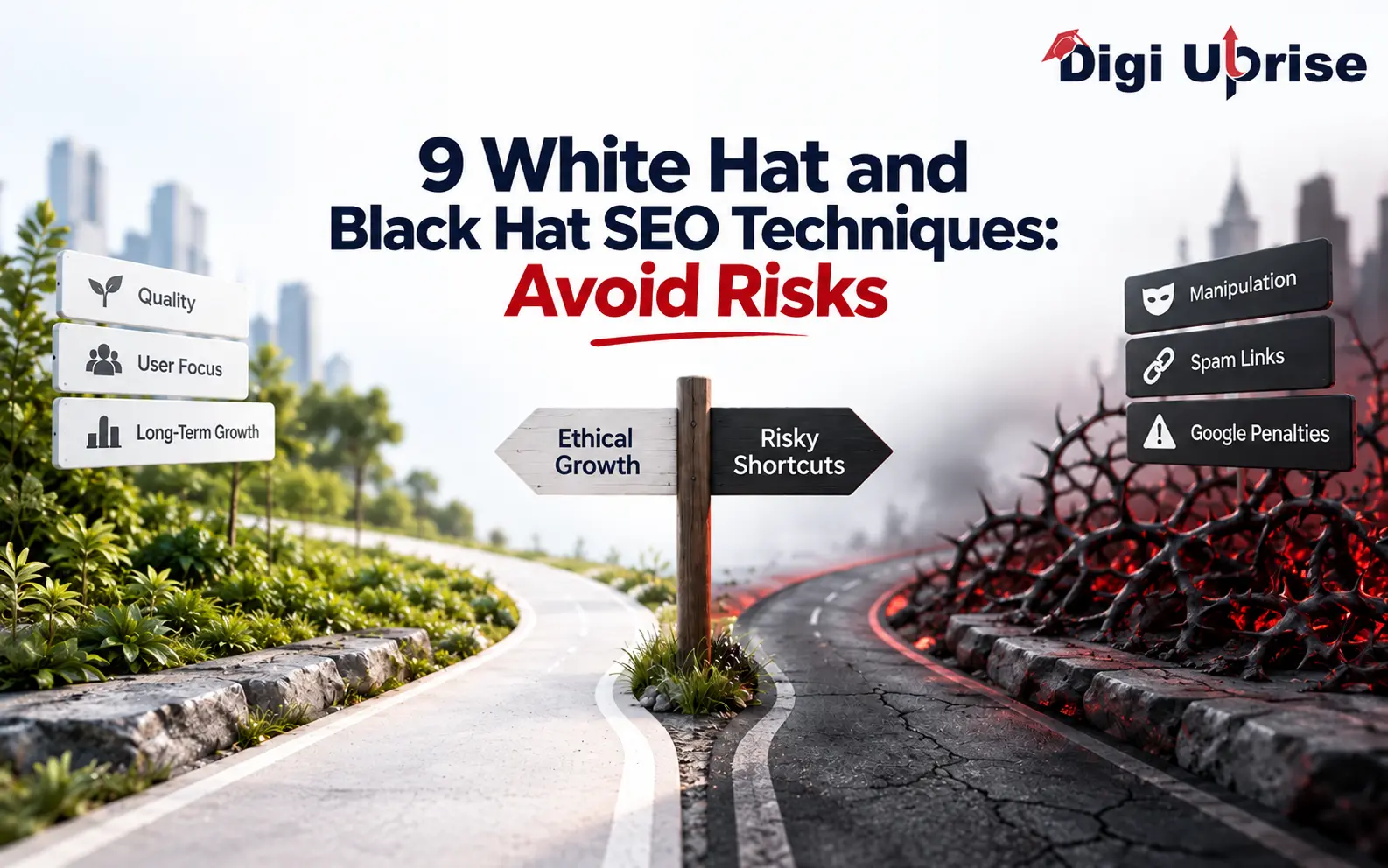
9 White Hat and Black Hat SEO Techniques: Avoid Risks
Share with Friends :

Table of Contents
Choosing the right SEO approach isn’t always easy. Get it wrong, and it could cost you a Google penalty. This is the choice that all web admins will sooner or later have to make between playing it safe with White Hat SEO or taking a risk with Black Hat SEO, two well-known approaches with very different track records.
In this blog, we will explain everything in detail through examples that will enable us to understand what works, what fails, and why. Our team at Digi Uprise will also tell you how we help our clients achieve lasting rankings with their websites.
What Are White Hat and Black Hat SEO?
Before we move to the list, let’s talk about some basic terms first. SEO is not one particular method; there is a spectrum of strategies, and their positioning on it will determine the level of risk for your website. Knowing what white hat SEO and black hat SEO techniques are will make it significantly easier for you to evaluate any SEO tactic offered by an agency in the future.
White hat SEO means applying SEO techniques that help improve the visibility of the website according to the recommendations given by the Google Search Engine guidelines. Unlike the second approach, it works for the benefit of the user rather than tricks, and therefore it works stably even after significant changes to algorithms.
Black Hat SEO techniques, in contrast, are those that contradict the search engine guidelines to get quicker ranking results. So, both of them are parts of the spectrum of White Hat and Black Hat SEO Techniques.
5 White Hat SEO Techniques You Should Use
Let’s dive into the safer side of this spectrum, starting with the techniques that provide lasting growth.
Since search engines love sites that truly provide value, it’s all about relevance, quality, and trustworthiness. Each of these techniques serves a different purpose, but all sit firmly on the low-risk end of the spectrum.
1. Publish Original, Research-Backed Content
The creation of original and research-based content can be considered one of the best White Hat SEO strategies today. A local bakery in Pune applied it through a baking tips article and was able to make it to page one within four months.
2. Optimize for Search Intent
Content that fulfills user intentions and does not only use a keyword can help keep users longer on your website. As a result, the ranking of your webpage will improve since Google monitors how users interact with your webpage.
3. Build Topic Clusters
The grouping of related articles around one leading service page gives search engines an insight into the authority of your website on the topic. In addition, it makes the process of finding related information convenient for your readers since they don’t need to leave the website, which, in turn, increases the time they spend on it, lowering the bounce rate.
4. Focus on E E A T Signals
Experience, expertise, authority, and trust have become the key elements for Google to estimate the content. Therefore, it is important to include author biographies, citations, references, and actual credentials to provide the right signal. The E E A T becomes especially critical when you write about health, financial, or safety-related topics.
5. Earn Backlinks Through Genuine Outreach
Contacting websites that have higher authority and asking for guest posts or mentions will increase your reputation slowly but reliably. These backlinks are not easy to acquire, and unlike paid backlinks, they do not vanish and do not cause penalties in the future.
Adhering to this list may require patience, but its effects tend to snowball each month as opposed to disappearing with just a single update. Those that manage to follow it throughout a whole year usually end up ranking well even after a huge Google update.
4 Black Hat SEO Techniques That Can Get You Penalized
On the riskier end of that spectrum, many businesses still get tempted by shortcuts promising instant results.
Here are the most common Black Hat tactics agencies warn clients to avoid, and why they sit on the risky end of these techniques.
1. Keyword Stuffing
Even though it helped some years ago, keyword stuffing is considered to be spam on both the user and Google sides. The content will not increase your rankings but decrease them as the text becomes unreadable for people in a few seconds.
2. Buying Low-Quality Backlinks
A huge number of irrelevant backlinks from poor-quality webpages may seem like a good choice in the beginning. This is a very popular black-hat technique that is still being offered in SEO services at low prices. Link spam detectors in Google have been created especially to catch such techniques, and the first indicator is an unnatural increase in the number of backlinks.
3. Cloaking
The technique of presenting different information to regular users and to search engine crawlers violates the guidelines and can cause a permanent deletion from the ranking page without any warning.
4. Using Private Blog Networks
One of the oldest black hat SEO practices is using private blog networks, and Google is known to actively find traces of such SEO practices. The eCommerce brand that we have worked with was once using this practice to rank quickly in a holiday campaign. They received a traffic surge for two weeks, and suddenly Google algorithm updates ruined all of their rankings, and it took them about eight months to rebuild everything back to normal.
Such techniques may result in quick ranking spikes; however, there is always a greater risk associated with them than rewards.
White Hat vs Black Hat SEO: Quick Comparison
The following table shows the major differences between these two SEO techniques in just a few words. Use it when an agency suggests a practice that is too fast to be good.
Goal | Black Hat SEO Techniques | White Hat SEO Alternative |
Rank faster | Keyword stuffing | Natural keyword placement |
Get backlinks | Black Hat link building networks | White Hat backlink outreach |
Improve CTR | Cloaking, misleading titles | Honest, benefit-driven titles |
Boost authority | Fake reviews | Real client testimonials |
While White Hat SEO may take time to implement and is sustainable, Black Hat SEO may work quickly but is very fragile. That single distinction is all one needs to know about why most successful companies avoid using the latter.
Which Approach Should Your Business Choose?
After weighing all nine strategies above, most companies prefer to play it safe. They can’t afford to lose their rankings overnight.
That said, companies do sometimes dabble in the gray area. As the name suggests, these strategies aren’t explicitly against the guidelines, but definitely push the boundaries. A safe white hat backlink profile is one of the most important factors in long-term ranking stability, and is worth more than any of the short-term gains. These gray hat moves should be done with caution, and only with the guidance of experts, because a single slip-up can take a website from the gray area into a penalty.
A pretty good rule of thumb for many SEOs: if a tactic needs to be hidden from Google, it’s best avoided entirely. That logic alone makes it easy to sort the safe strategies from the risky ones.
Final Thoughts: Choosing the Right SEO Strategy
Deciding how much risk your business is willing to accept is the only way to find the right balance between the two.
At Digi Uprise, we have helped dozens of clients recover from Black Hat link building penalties and rebuild their organic traffic using a clean, proven White Hat backlink strategy. Our team focuses on approaches that protect your website long after the campaign ends.
Want to check out transformations done by actual clients and learn some quick SEO tips? You can find all of our tutorials and case studies on the Digi Uprise Instagram and YouTube accounts.
If you are ready to grow your rankings the safe and lasting way, reach out to the Digi Uprise team today and let’s build an SEO strategy that actually works for your business.
Frequently Asked Questions
1. Is black hat SEO illegal?
According to the law, black hat SEO is not illegal, but it breaks the rules of search engines, and these companies can choose to punish offenders by dropping the rankings or even banning them from their search results.
2. Can a website recover after using risky SEO tactics?
Yes, but it will take time. Bad links will need to be removed, any technical issues will also need to be fixed, and there will need to be a prolonged white hat backlink and content strategy.
3. What is gray hat SEO?
Gray hat SEO is a little riskier than white hat SEO and is in a bit of a middle ground with black hat SEO. It is more or less within the guidelines of safe practices, but a little risky. Agencies choose to avoid this kind of SEO entirely because it is too difficult to fully understand the risky line.
4. How do I know if my SEO agency uses black hat methods?
There will be a lack of transparency. They will most likely show fast results at a cheaper cost than other agencies, have vague reports for backlinks, claim unknown sources for their backlinking services, and lack transparency for their backlinking practices. A genuine agency will not hold back reports and will always explain their practices.
5. Which of these White Hat and Black Hat SEO Techniques works fastest?
Black Hat techniques will provide faster, albeit unstable results. White Hat SEO will take roughly a few months to produce results, which will be much more stable.