

- September 17, 2026
Search Intent: 4 Types, Examples & SEO Tips for 2026
Share with Friends :

Table of Contents
Search intent is the reason behind every search query, what a user actually wants when they type something into Google. Understanding search intent is the foundation of a content strategy built around user intent: creating content that matches what users expect to find, rather than just targeting keywords. Every Google search has a purpose, whether the user wants an answer, finds a specific website, compares options, or takes an action.
When content matches that purpose, it has a better chance of satisfying users and supporting SEO performance. This complete guide from Digi Uprise explains what search intent is, the main types of search intent, how search intent splitting works, and how to create content that matches user expectations.
What Is Search Intent?
Search intent refers to the intention behind a search query. Whenever anyone searches on Google, they do so with some purpose in mind. This purpose can include looking for answers, specific websites, comparisons, or actions.
For example, someone who enters “what is SEO” would be looking for information; someone who enters “best SEO course in Delhi” would be making comparisons, whereas someone who enters “join SEO course” would be closer to taking action.
Understanding this helps marketers create pages that satisfy these different needs, rather than focusing only on keywords.
Why Does It Matter?
Search engines want to provide useful results. If a webpage targets a keyword but does not satisfy the reason behind the search, it may struggle to perform well.
This can influence:
- Content format
- Keyword selection
- Page structure
- Internal linking
- Conversion strategy
What Are the Main Search Intent Types?
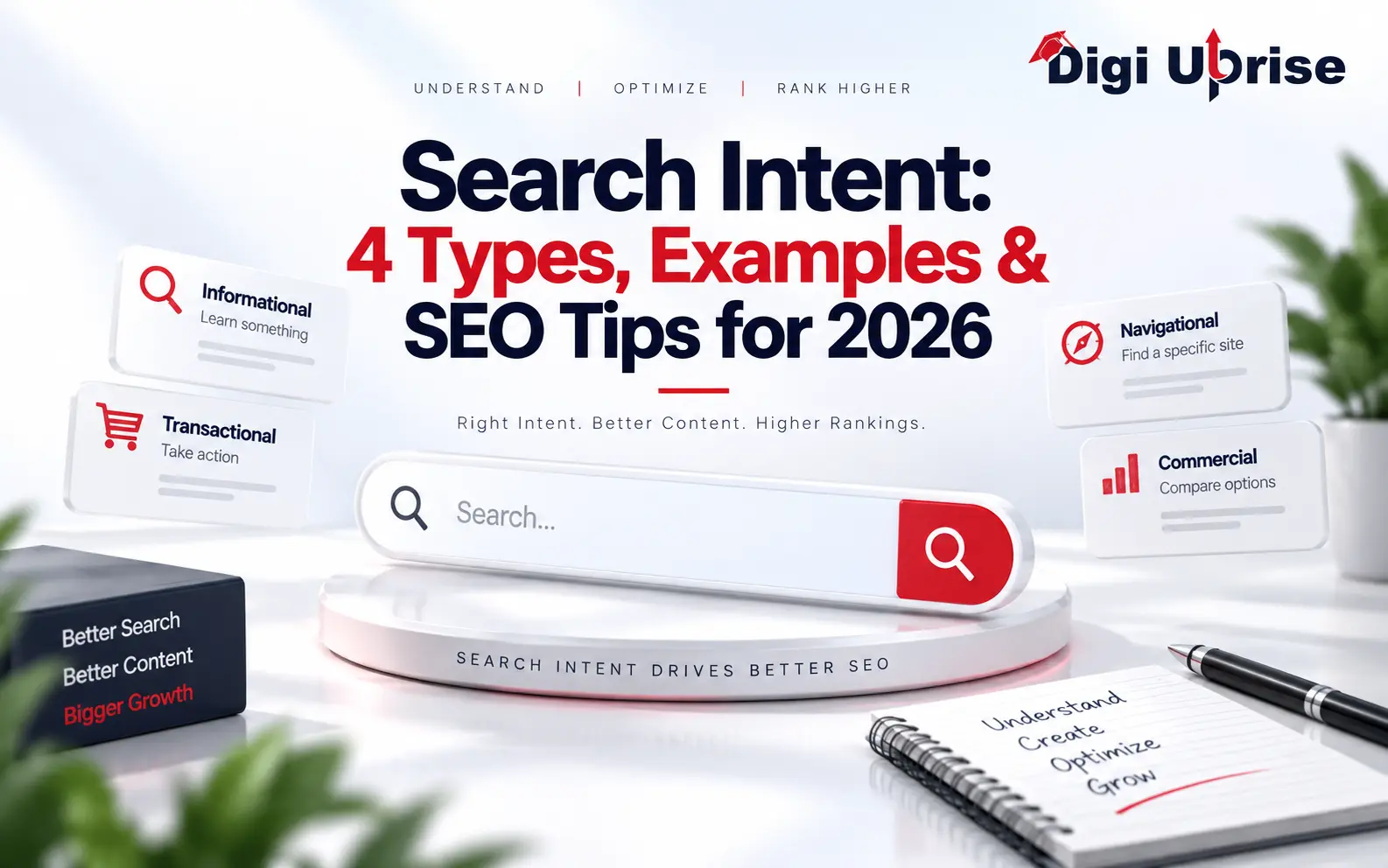
There are four commonly discussed primary types of search intent: informational, navigational, commercial, and transactional. Local intent is also important for searches where users are looking for businesses, services, or information in a specific location.
| Intent type | Main purpose | Example |
| Informational | Learn something | What is SEO? |
| Navigational | Find a specific destination | Digi Uprise |
| Commercial | Research before choosing | Best SEO course |
| Transactional | Complete an action | Enroll in SEO course |
Informational Intent
Informational intent occurs when users want knowledge or an answer, such as “what is digital marketing?” or “how does SEO work?” Blog posts, tutorials, guides, and educational videos are usually the best format for these queries.
Navigational Intent
This type of intent occurs when people are looking to reach a specific website, brand, or page. For example, someone who looks for “Digi Uprise” knows about the brand and wants to go to the website. Effective brand pages and navigation will serve this purpose.
Commercial Intent
The presence of commercial intent can be observed when a person is researching something before making up their mind on the matter, such as “best digital marketing course” or “SEO course reviews”. Articles about comparisons, reviews, and services are suitable for this case.
Transactional Intent
When the purpose is to take an action, such as “buy an SEO course” or “enroll in a digital marketing course”, that is transactional intent. Pages with transactional intent should have a well-defined call-to-action.
How Does Search Intent Splitting Work?
Search intent splitting means dividing related keywords into groups according to the purpose behind each search. This is a core technique for matching content to user intent, especially when a keyword list contains searchers with different goals.
Think about “digital marketing course.” Some of its related queries may be:
- What is a digital marketing course?
- Best digital marketing course
- Digital marketing course fees
- Digital marketing course near me
- Join digital marketing course
Query | Likely intent | Recommended page |
What is a digital marketing course? | Informational | Blog |
Best digital marketing course | Commercial | Course guide |
Digital marketing course fees | Commercial | Fees page |
Digital marketing course near me | Local | Location page |
Join digital marketing course | Transactional | Enrollment page |
Why Is Intent Grouping Useful?
If a website creates one article targeting every keyword related to a topic, the page can become too broad and fail to answer specific questions properly. Search intent splitting solves this by giving each page a clear focus so that informational content can guide users toward commercial and transactional pages.
How Can You Identify Search Intent?
Identifying search intent is not always a difficult process. In fact, Google provides useful hints about this.
Study Google’s Results
Search your target keyword and examine the first page: titles, content formats, featured snippets, videos, local results, or product pages. If detailed guides dominate, the keyword likely has informational intent. If service pages dominate, it likely has commercial or transactional intent.
Examine the Wording
Words in query | Possible intent |
What, why, how | Informational |
Best, top, review | Commercial |
Buy, book, enroll | Transactional |
Brand or website name | Navigational |
These patterns are useful clues, but they should not replace actual SERP analysis.
Look at the Expected Outcome
Ask what the searcher wants to accomplish. “How to learn SEO” suggests educational guidance is needed. “SEO course with internship” suggests the person is researching options. “Enroll in SEO course” is much closer to a transaction.
How Do You Match Content With Search Intent?
A simple process for aligning content with search intent:
- Choose your primary keyword.
- Collect related search queries.
- Group keywords by purpose.
- Analyse the current search results.
- Select the right page format.
- Answer the user’s main need clearly.
- Add relevant internal links.
- Review performance and update the page when necessary.
Match Content to the Searcher’s Stage
An informational article should educate rather than immediately push a sale. A commercial page should help users compare options. A transactional page should make the desired action easy to complete.
For example, a blog about “What Is SEO?” can include links internally to the SEO course page that has curriculum, training, and enrollment information, thus making the journey logical.
Use Content Formats Strategically
Intent | Suitable formats |
Informational | Blog, guide, tutorial |
Navigational | Homepage, brand page |
Commercial | Comparison, review, service page |
Transactional | Product, course, or booking page |
Common Mistakes to Avoid
Even a strong intent-based content strategy can fail when intent is misunderstood.
Focusing only on search volume: A smaller keyword with strong transactional intent may be more valuable than a broad informational keyword.
Targeting different intents on one page: Answering informational, commercial, and transactional queries on one page can make content unfocused. Splitting keywords by purpose helps decide which ones should share a page.
Ignoring SERP changes: A primarily informational keyword may gradually develop stronger commercial intent, so important pages should be reviewed periodically.
Copying the ranking pages: Competitor results can help you understand intent, but copying their structure or wording will not generate good content; hence, add your own examples and explanations.
Forgetting the user experience: The intent of users does not just end at the search result; it continues when the user opens the page looking for what they expected to find.
Conclusion
Understanding search intent allows marketers to move beyond simply placing keywords and focus on what users actually want from their searches. Applying that understanding, matching each page to what the searcher actually wants, is what turns insight into better-performing pages. In addition, knowledge of major search intents and search intent splitting, as well as matching intent with content, will help generate a better page.
Digi Uprise is dedicated to providing practical digital marketing education and assists its users in gaining knowledge in crucial areas like SEO and digital marketing. You can follow Digi Uprise on Instagram and YouTube for digital marketing education-related content.
Ready to improve your SEO skills? Explore Digi Uprise’s digital marketing learning programs and start building practical knowledge today.
Frequently Asked Questions
1. What is the easiest way to get started with search intent optimization?
Search for the keyword using Google and analyze the results. The format of pages, titles, and other features on the first page give an indication of user and Google intent.
2. Is this the same as keyword research?
No. Keyword research is about discovering what people search for, while search intent is the purpose behind their search.
3. Can search intent change over time?
Yes. User behaviour, trends, products, and search results can change, so regularly reviewing important keywords helps keep content aligned with expectations.
4. Which intent type is best for generating leads?
Both commercial and transactional intent searches are closer to the conversion stage, but informative content also creates a sense of trust that drives people to the right pages.
5. Should every website page target a different intent?
No, because related questions that have the same goal can be placed on one page without making it too generic.
6. What are the four main types of search intent?
The four commonly discussed types are informational, navigational, commercial, and transactional search intent. Each represents a different reason why someone performs a search.
7. How do I determine the search intent of a keyword?
Search the keyword on Google and examine the results. Look at the types of pages ranking, content formats, featured snippets, local results, videos, and other SERP features to understand what users are likely expecting.
8. Why is search intent important for SEO?
Search intent helps you create content that matches the user’s purpose. When a page provides the information, comparison, or action a searcher expects, it can provide a more relevant and useful search experience.