

- September 24, 2026
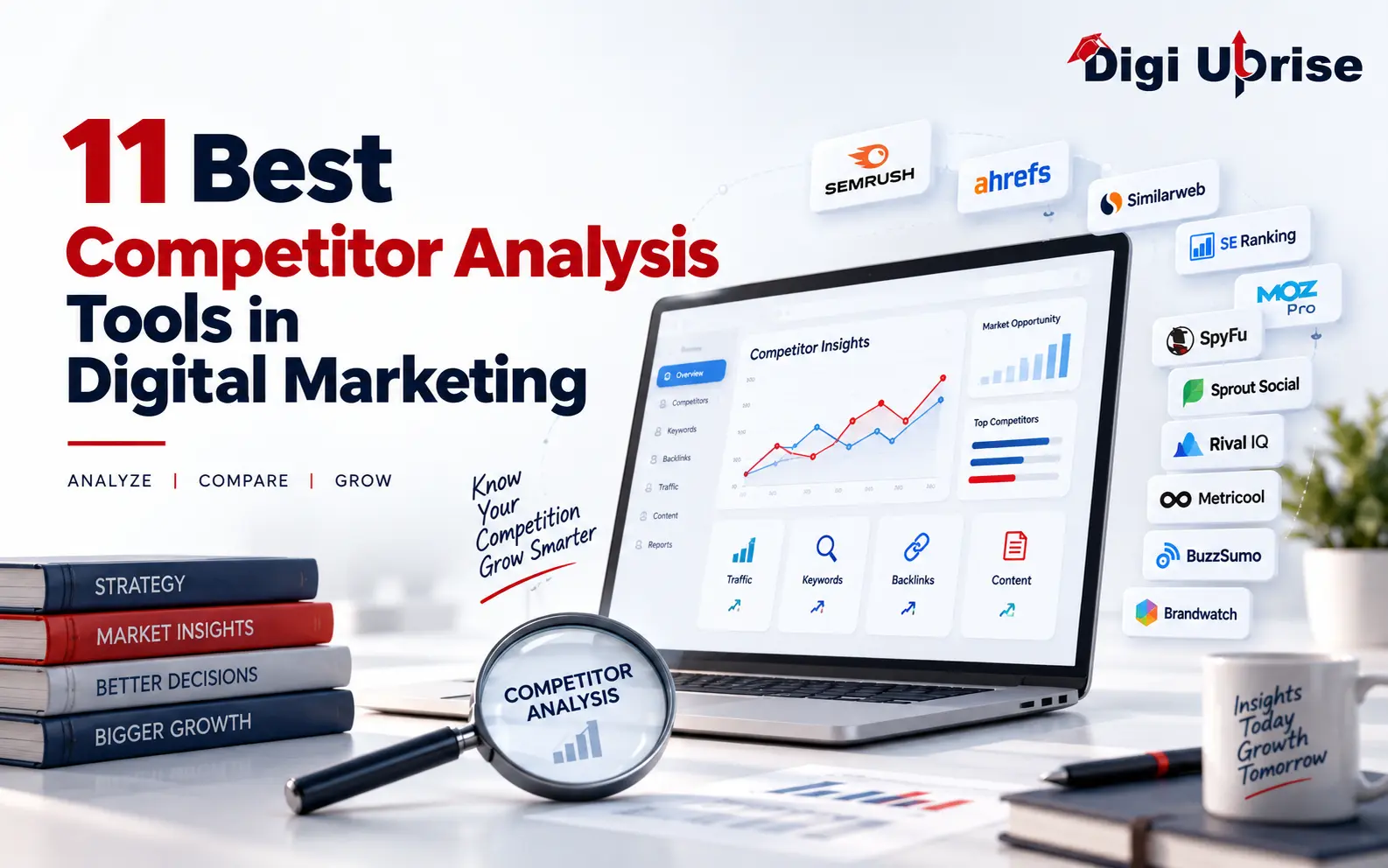
11 Best Competitor Analysis Tools in Digital Marketing
Share with Friends :

Table of Contents
Why Do You Need Competitor Analysis Tools?
Your competitors may be ranking for keywords you don’t, running ads you haven’t seen, or publishing content that attracts your target audience. The challenge is figuring out what they are doing without spending hours manually checking their websites, ads, and social media.
That’s where competitor analysis tools in digital marketing can help. At Digi Uprise, we teach students to treat competitor research as an ongoing habit, not a one-time audit, and the right software makes that habit far easier to keep.
This guide covers 11 competitor analysis tools, what each one does best, and how to choose the right option based on your budget and marketing goals.
What Do Competitor Analysis Tools Do?
Competitor analysis tools collect data about competitors’ SEO, advertising, content, and social media activity and turn it into useful insights. Instead of guessing why a competitor is outperforming your content, you can analyze factors such as keywords, backlinks, rankings, and engagement.
Competitor analysis tools can generally be categorized into a few main types:
- SEO and content analysis tool for keyword rankings, backlinks, and organic traffic monitoring
- Paid media tool for ad copy, landing pages, and cost per click estimates
- Social media monitoring tool for post frequency, engagement, and audience building
- All-in-one platform combination of several tools in a single platform
Knowing which category you need can make it easier to choose the right competitor analysis tool.
How to Choose the Right Tool for Your Team
Before you subscribe to a tool, know exactly what you want to learn. A freelance SEO consultant and an in-house social media manager may need very different features, even though both are researching competitors.
Think about these questions:
- Which channel is most important to track at this moment?
- Is it organic, paid, or social search?
- Do you need historical trends, or are you mainly looking for a current snapshot?
- Is it meant for a single user, or must your whole team have access to it?
- Will you have time to review the data regularly and act on the insights?
A tool becomes valuable when someone regularly reviews the data and turns it into actionable insights. Simply having access to competitor data is not enough.
11 Competitor Analysis Tools for Digital Marketing
Below are 11 competitor analysis tools, each with different strengths across SEO, paid advertising, social media, and content research.
1. Semrush
Semrush is a widely used competitive research platform for SEO, paid search, content research, and digital marketing analysis. Semrush helps marketers compare keyword rankings, research competitors’ paid search activity, analyze backlink profiles, and identify content opportunities. Its Keyword Gap tool is one of its most useful features.
2. Ahrefs
Ahrefs is widely used for backlink and SEO research. Its Site Explorer can help analyze competitors’ organic keywords, backlinks, top-performing pages, and estimated search traffic. Marketers use the platform to figure out why a particular page earns a high ranking and then replicate the process for their content.
3. Similarweb
Similarweb provides traffic and channel analytics instead of information at a keyword level. This platform helps you understand how competitors acquire traffic through search, social media, referrals, and direct visits, making it easier to evaluate their marketing mix.
4. SE Ranking
SE Ranking combines rank tracking, keyword research, site audits, and competitor analysis in a single platform. SE Ranking is a good choice for companies that manage more than one client account and want thorough competitive analysis.
5. Moz Pro
Moz Pro’s Link Explorer is still a reliable tool for backlink and domain authority analysis. It helps marketers compare their backlink profiles with competitors and identify potential link-building opportunities.
6. SpyFu
SpyFu focuses heavily on competitor research for paid search and SEO. The tool provides competitive keyword data, historical ad information, and estimates related to competitors’ paid search activity.
7. Sprout Social
Competitive Analytics from Sprout Social helps you benchmark the performance of your social media campaigns relative to other companies. You can compare metrics such as content frequency, audience growth, and engagement across social channels with your selected competitors.
8. Rival IQ
Rival IQ is a competitive analysis platform that monitors posting patterns, interactions, and followers on social media sites such as Instagram, TikTok, Facebook, LinkedIn, and YouTube. The boosted-post detector identifies whether a competitor’s post was paid; that way, you’re comparing organic posts against organic posts.
9. Metricool
Metricool combines social media scheduling, analytics, and competitor monitoring in one platform. It can be useful for small teams that want to manage social media and competitor research in one platform.
10. BuzzSumo
BuzzSumo focuses on content research and discovery. BuzzSumo can help identify competitors’ high-performing content using signals such as social engagement and backlinks. These insights can inform new topics, formats, and content angles.
11. Brandwatch
Brandwatch is a social listening platform that monitors more than just competitor accounts, measuring everything from brand mentions to sentiment across the web. Its broader monitoring capabilities make it more suitable for organizations that need large-scale social listening and consumer insights.
Quick Comparison Table
| Tool | Best For | SEO | Paid Ads | Social Media | Content |
| Semrush | All-round competitor research | ✓ | ✓ | ✓ | ✓ |
| Ahrefs | Backlink & SEO analysis | ✓ | — | — | ✓ |
| Similarweb | Traffic & channel analysis | ✓ | ✓ | ✓ | — |
| SE Ranking | Rank tracking & SEO research | ✓ | — | — | ✓ |
| Moz Pro | Backlink & SEO analysis | ✓ | — | — | ✓ |
| SpyFu | PPC & competitor keyword research | ✓ | ✓ | — | — |
| Sprout Social | Social media benchmarking | — | — | ✓ | — |
| Rival IQ | Social competitor analysis | — | — | ✓ | ✓ |
| Metricool | Social media management & analysis | — | — | ✓ | ✓ |
| BuzzSumo | Content research | ✓ | — | ✓ | ✓ |
| Brandwatch | Social listening & brand intelligence | — | — | ✓ | ✓ |
Building a Simple Competitor Research Workflow
Competitor research becomes far more valuable when it is part of a consistent workflow.
A simple workflow that works for most teams:
- Pick two or three direct competitors to track consistently, rather than trying to monitor everyone in your space.
- Choose one or two competitive research tools that match your primary marketing channel, not all 11 of them.
- Set aside a specific day each week or every two weeks to review competitor activity and identify new opportunities.
- Turn those insights into actions such as creating a content brief, targeting a new keyword, or testing ad copy.
The goal isn’t to use the most advanced platform. It’s to consistently turn competitor data into useful actions. Choose competitor research software that fits your actual workflow rather than selecting a feature-heavy platform that your team rarely uses.
Conclusion
No single tool on this list is suitable for every team. The right option depends on the channels you want to monitor and the time your team can invest in analyzing the data. You can start with one or two tools that match your current needs, establish a regular research routine, and gradually expand your toolkit.
If you want to learn how to turn your competitor analysis results into an actual marketing strategy, we cover this practical skill in our SEO and digital marketing classes at Digi Uprise.
Frequently Asked Questions
1. What is the best free competitor analysis software?
Several competitor analysis platforms offer free plans, limited free features, or free trials. The available features and usage limits vary by platform, so check each tool’s current plan before choosing one.
2. How often should you perform a competitor analysis?
The best practice for most marketers involves checking competitor information on a weekly or biweekly basis for ongoing marketing campaigns, while a quarterly analysis gives a more thorough view. It all depends on how rapidly the changes happen in your industry and with your competitors.
3. Is there an SEO/ads/social media tool that covers all my needs?
Several platforms cover multiple marketing channels, but the features and depth of analysis vary. Many teams use an SEO-focused tool alongside a social listening or social media analytics platform. It’s common to use one SEO tool and one social listening tool.
4. Are competitor analysis tools useful only for SEO purposes?
No. Competitor analysis tools can also support research for paid advertising, content marketing, social media, traffic sources, and broader market positioning.
5. Can these tools reveal the accurate number of competitors' traffic?
Most likely, no, as most platforms rely on modeled data and do not show real competitors’ analytics.