- October 6, 2026
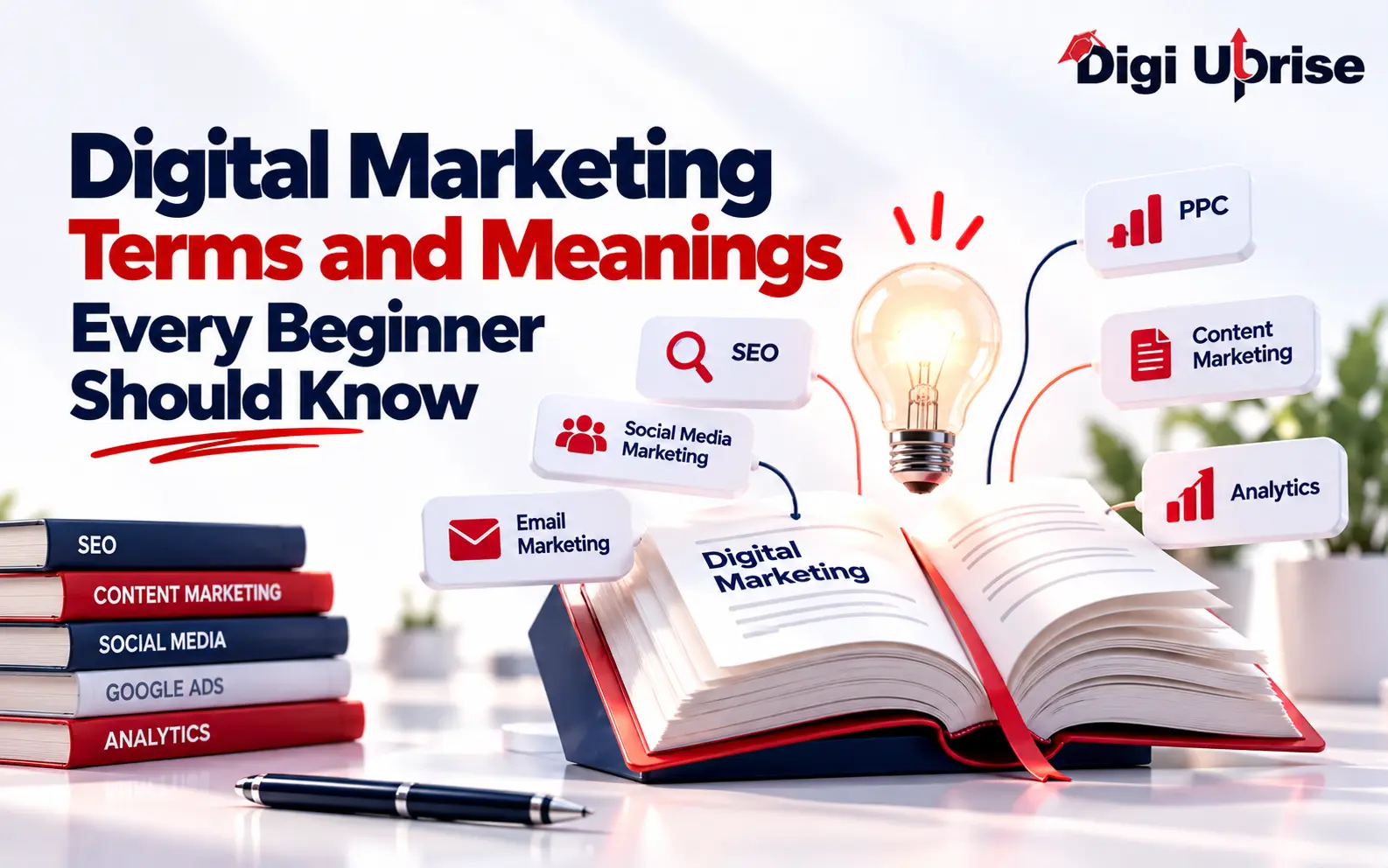
Digital Marketing Terms and Meanings Every Beginner Should Know
Share with Friends :

Table of Contents
Have you ever heard terms like CTR, CPC, SERP, ROAS, or SEO and wondered what they actually mean? As you might have guessed, digital marketing has its own language, and it is necessary to know this language to understand campaigns, reports, meetings with clients, and other marketing activities.
This digital marketing glossary explains the most important digital marketing terms and meanings in simple English. It covers SEO, paid advertising, social media, content marketing, email marketing, analytics, conversion optimization, and AI search.
What Are Digital Marketing Terms?
Digital marketing terms are words, abbreviations, and metrics used to describe online marketing activities. Common examples include SEO, PPC, CPC, CTR, SERP, ROAS, conversion rate, and lead generation. Understanding these terms helps beginners interpret marketing reports, measure campaign performance, and make informed marketing decisions.
Why Understanding Digital Marketing Terminology Matters
Not all terms that relate to marketing have to be known by heart in order to be a successful digital marketer. However, knowing terms that are frequently used is helpful because they allow you to:
- Read SEO and advertising reports
- Communicate with clients and marketing teams
- Understand analytics dashboards
- Measure campaign performance
- Follow digital marketing courses more easily
- Make better marketing decisions
SEO Terms and Meanings
Term | Meaning |
SEO | Search Engine Optimization is the process of improving a website to increase its visibility in organic search results. |
SERP | Search Engine Results Page refers to the page returned by a search engine after a search. |
Keyword | A word or phrase users enter into search engines to find information, products, or services. |
Search Intent | The reason or goal behind a user’s search query. |
Long-Tail Keyword | A specific search phrase, usually containing several words, that targets a narrower search intent. |
Organic Traffic | Visitors who reach a website through unpaid search results. |
Backlink | A link from another website to your website. |
Internal Link | Linking from one page on your site to another page within the same website. |
Crawling | The process through which search engines find and gain access to web pages. |
Indexing | The process of storing and processing webpages so they can potentially appear in search results. |
Meta Title | The title associated with a webpage that can appear as the clickable headline in search results. |
A short description that can appear below a page title in search results. | |
Technical SEO | Improving the technical aspects of a website to help search engines crawl, understand, and index it effectively. |
Alt Text | Text describing an image, primarily used for accessibility and to help search engines understand image content. |
Paid Advertising Terms
Paid advertising uses terms related to clicks, costs, impressions, and conversions.
Term | Meaning |
Pay-Per-Click is an advertising model where advertisers pay when users click an advertisement. | |
CPC (Cost Per Click) | The amount paid for each click on an advertisement. Average CPC is calculated by dividing the total cost of clicks by the number of clicks. |
CPM | Cost Per Mille is the cost of delivering 1,000 ad impressions. |
CPA (Cost Per Acquisition) | The average cost of generating a defined acquisition or conversion, depending on the campaign’s measurement goals. |
CPL | Cost Per Lead measures the average cost of generating a lead. |
CTR (Click-Through Rate) | The percentage of impressions that result in clicks on an ad, link, or other clickable content. |
Impression | An instance where an advertisement or piece of content is displayed. |
Conversion | A desired action completed by a user, such as making a purchase or submitting a form. |
ROAS (Return on Ad Spend) | A metric that measures the revenue attributed to advertising compared with the amount spent on ads. It is calculated by dividing attributed revenue by advertising spend. For example, if an advertising campaign generates ₹10,000 in attributed revenue from ₹2,000 in ad spend, its ROAS is 5x. |
Landing Page | A webpage designed to receive campaign traffic and encourage a specific action. |
Showing marketing messages to people who have previously interacted with a website, brand, or campaign, depending on the platform and available signals. |
Social Media Marketing Terms
Term | Meaning |
Social Media Marketing | Using social platforms to build awareness, engage audiences, generate leads, or drive sales. |
Reach | The number of unique users who see a piece of content or campaign. |
Engagement | Interactions with content, such as likes, comments, shares, saves, or clicks. |
Engagement Rate | A measure of engagement in relation to a defined audience or exposure base, such as reach or impressions. |
UGC | User-Generated Content is content created by customers or users rather than directly by the brand. |
Collaborating with individuals who have an established audience to promote a product, service, or idea. | |
Social Listening | Monitoring online conversations and mentions to understand what people are saying about a brand or topic. |
Content and Email Marketing Terms
Term | Meaning |
Content Marketing | Creating and distributing useful content to attract, educate, engage, and retain an audience. |
Content Strategy | A planned approach for deciding what content to create, for whom, and how it will be distributed and measured. |
Content Calendar | A schedule used to plan and organize upcoming content. |
Evergreen Content | Content that can remain useful and relevant for a long period with limited updates. |
Lead Magnet | A useful resource offered to encourage users to provide their contact information. |
CTA | Call to Action is a prompt encouraging users to take a specific action, such as “Sign Up” or “Download.” |
Open Rate | The percentage of delivered emails recorded as opened. Open tracking can be affected by privacy and technical factors. |
Email Bounce | An email that cannot be delivered to the intended recipient. |
Email Segmentation | Dividing an email audience into groups based on characteristics, behavior, interests, or other criteria. |
Drip Campaign | A sequence of automated emails sent according to predefined timing or triggers. |
Analytics and Conversion Terms
Analytics helps marketers understand traffic, user behavior, and campaign performance.
Term | Meaning |
GA4 | Google Analytics 4 is Google’s analytics platform for measuring interactions across websites and apps. |
User | A metric representing users interacting with a website or app according to the analytics platform’s methodology. |
Session | A period of interaction with a website or app as defined by the analytics platform. |
Event | A recorded interaction or occurrence, such as a click, page view, form submission, or purchase. |
KPI | Key Performance Indicator is a measurable value used to evaluate progress toward a marketing or business objective. |
Attribution | The process of assigning credit for a conversion or outcome to one or more marketing touchpoints. |
Funnel | A model representing the stages users move through before completing a desired action. |
CRO | Conversion Rate Optimization is the process of improving digital experiences to increase desired conversions. |
A/B Testing | Comparing two versions of a webpage, email, advertisement, or other asset to determine which performs better. |
Lead | A person or organization that has shown interest in a product or service and may become a customer. |
AI and Modern Search Marketing Terms
AI is changing how people search for information and how marketers create and distribute content.
Term | Meaning |
Artificial Intelligence (AI) | Technology that enables computer systems to perform tasks that typically require human intelligence. |
Generative AI | AI systems capable of generating content such as text, images, audio, video, or code. |
LLM | Large Language Model is an AI model trained on large amounts of data to process and generate language. |
AEO | Answer Engine Optimization focuses on creating content that can provide useful answers in answer-focused search experiences. |
GEO | Generative Engine Optimization is an emerging approach focused on making content easier for generative AI systems to understand and potentially cite. |
AI Overviews | AI-generated summaries that may appear within search results to answer certain queries. |
Zero-Click Search | A search where users get the information they need directly from the search results or search interface without clicking another website. |
Prompt Engineering | Designing and refining instructions to obtain useful results from AI systems. |
How to Remember Digital Marketing Terms
It is impossible to remember all digital marketing terms just by reading the glossary once. In order to master digital marketing vocabulary, it is necessary to relate each term to practice.
Do your best to:
- Apply SEO terms to a real website.
- Review CPC, CTR, and conversion data from an advertising campaign.
- Create a content calendar.
- Analyze website traffic using an analytics platform.
- Build a simple conversion funnel.
- Practice creating CTAs and landing pages.
- Use AI tools for practical marketing tasks.
For example, instead of only memorizing the definition of CTR, look at an actual campaign and calculate how many people clicked after seeing the advertisement.
Where to Learn These Terms in Practice
Digital marketing terms become much more comprehensible when applied to practical marketing activities, analytics dashboards, paid advertisements, content strategy, etc.
At Digi Uprise, practical digital marketing training focuses on applying concepts such as SEO, paid advertising, analytics, content marketing, and AI tools rather than only memorizing definitions.
Conclusion
Understanding digital marketing terms is the first step toward working confidently with SEO, advertising, analytics, and AI-powered marketing tools. Apply these concepts to real campaigns, review performance reports, and keep building your skills through practice.
At Digi Uprise, learners can explore practical digital marketing concepts and follow us on YouTube and Instagram for marketing tips, industry updates, and learning resources.
Frequently Asked Questions
1. What digital marketing terms should beginners learn first?
Beginners should know SEO, keywords, SERP, organic traffic, PPC, CPC, CTR, conversion rate, leads, CTA, engagement rate, ROAS, and analytics. Such terms are often used in digital marketing.
2. What is the difference between SEO and PPC?
While SEO is associated with organic optimization, PPC implies the use of paid ads, in which the advertiser usually pays per click.
3. What is CTR in digital marketing?
CTR stands for Click-Through Rate. It is calculated by dividing clicks by impressions and multiplying by 100.
4. What is a conversion in digital marketing?
A conversion refers to an action that is completed by the user. It may refer to purchasing, form filling, signing up, booking, or downloading.
5. What is ROAS?
ROAS stands for Return on Ad Spend. It compares revenue attributed to advertising with the amount spent on those advertisements.
6. What are AEO and GEO?
AEO stands for Answer Engine Optimization and focuses on answer-oriented search experiences. GEO, or Generative Engine Optimization, is an emerging approach focused on making content easier for generative AI systems to understand and potentially cite.
7. Do you need coding knowledge to learn digital marketing?
No. Most digital marketing concepts can be learned without advanced coding knowledge. Basic technical knowledge can, however, be useful for technical SEO, analytics, tracking, and marketing technology.