- October 16, 2026
What Is PPC Marketing? How It Works, Types, and Benefits
Share with Friends :
Table of Contents
You can have a great product, a clean website and a fair price, and still get nothing but silence from your enquiry form. It happens far more often than business owners like to admit. The product usually isn’t the problem. The people who need it just haven’t come across it yet.
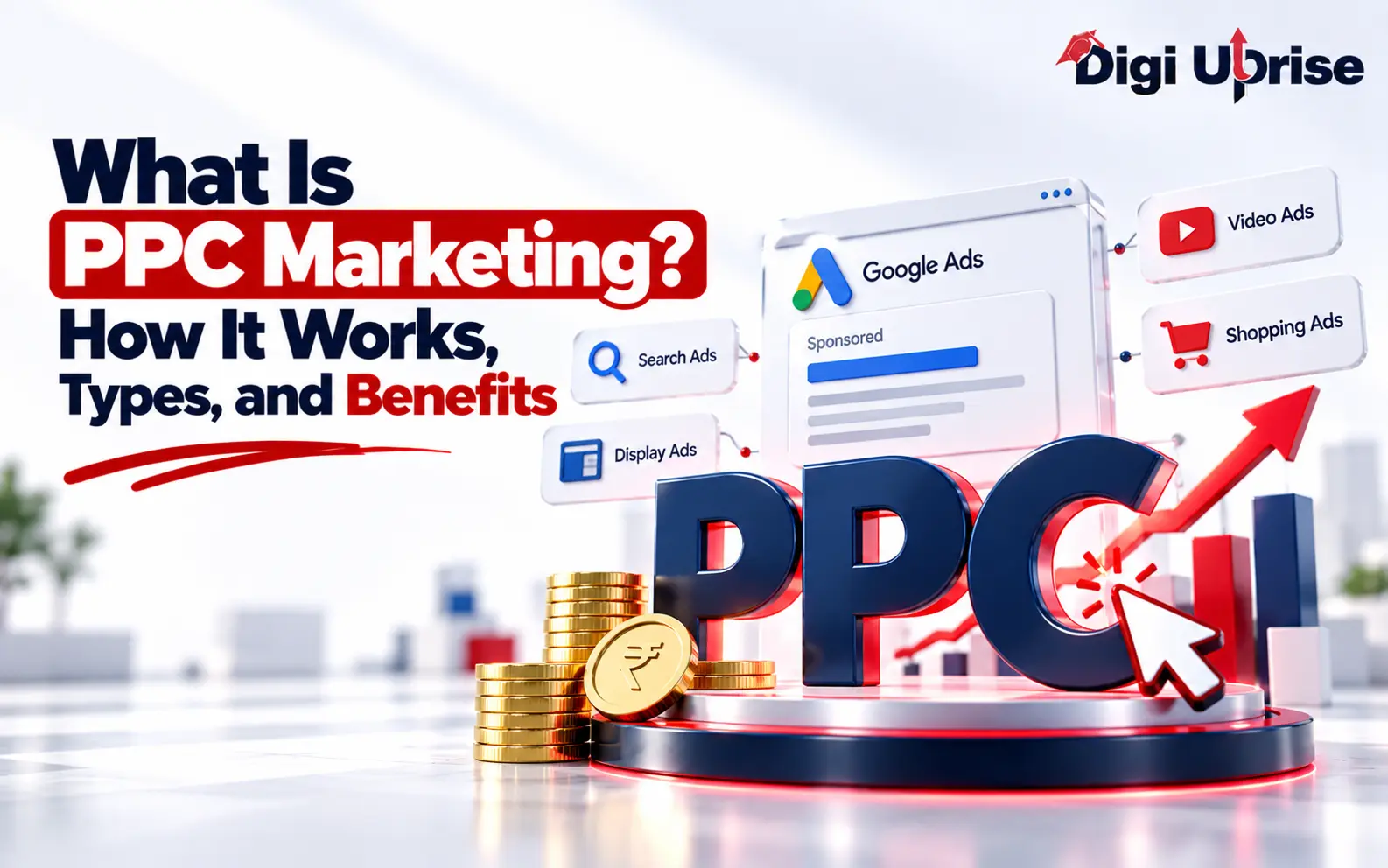
PPC marketing (pay-per-click marketing) is a digital advertising model in which advertisers generally pay when someone clicks their ad. Businesses use PPC campaigns on search engines, social media platforms, and other advertising networks to attract relevant visitors, generate leads, and increase sales. Campaign performance depends on targeting, ad relevance, landing pages, and conversion tracking.
But paying for clicks is only the starting point. You still have to decide who you’re speaking to, what you’ll say, how much you’re prepared to spend, and what a visitor sees once they land on your site. Get those wrong and you can collect hundreds of visits without a single real enquiry. Plenty of budgets disappear exactly that way.
So instead of stopping at the click, this guide follows the whole path, from the ad to the result.
How Does PPC Marketing Work?
Every campaign should begin with a goal, not an ad. Maybe you want more product sales, more course registrations, more service enquiries, or simply more qualified visitors on your site. Whichever it is, that goal shapes everything that follows: who you target, which ad format you pick, and how you’ll decide whether the campaign worked.
Search Intent: Matching the Ad to the Question
Picture someone typing “digital marketing course in Delhi” into Google. They’re probably not browsing for fun. They might be comparing institutes, hunting for a syllabus, or trying to work out where to enrol. An institute that shows an ad speaking to exactly that need, and sends the person to a page about the course, has a real chance of earning the click.
A vague, catch-all ad might get noticed. An ad that mirrors what the person was actually looking for gives them a reason to act.
What Happens Behind the Scenes in an Ad Auction?
Every time someone runs a search, the platform decides which ads are eligible to appear, using an auction. Your bid matters, but it isn’t the only thing that counts. Depending on the platform, relevance, expected performance and the quality of the experience you offer also play a part. So the highest bidder doesn’t automatically win.
When someone clicks your ad, you’re usually charged according to the bidding method you chose. Then the visitor arrives on your landing page, and that’s the moment interest either becomes action or quietly leaves. It’s why the ad and the landing page should be planned together, not handed to two people who never talk to each other.
Depending on the platform, relevance, expected performance and the quality of the experience you offer also play a part. Google explains these factors in its guide to how the Google Ads auction works.
What Are the Different Types of PPC Advertising?
Not every ad format solves the same problem. Some put you in front of people who are already looking for what you sell. Others introduce your brand to people who didn’t know you existed.
Search Ads: Catching Demand That Already Exists
Search ads show up in search engine results when someone types a relevant query. They suit businesses whose customers already know what they need and are actively looking.
Take someone searching for website development services. They’re usually much more receptive to a relevant service ad than a person scrolling the internet with no particular need in mind. That’s why search advertising leans so heavily on keyword choice, and on understanding what a query really means rather than just what it says.
Display and Video Ads: Building Interest
Display ads are visual placements on partner websites and apps. Video ads use motion and sound to explain a product, show a service in action, or introduce a brand.
These formats are handy when your message is too big for a few lines of search ad text. A software company, for example, could use a short video to show how its tool solves one specific headache. Whether they work comes down to two things: reaching the right audience, and saying something worth stopping for.
Shopping and Social Media Ads: Putting the Offer in View
Shopping ads can display product images, prices and other details right in the results. Social media ads let businesses promote offers and content to chosen audiences on supported platforms.
An online store might lean on product-led ads, while a training institute could promote a course to people whose interests or online behaviour suggest it might suit them. The best format isn’t always the most popular one. It’s the one that fits your goal, your audience and the resources you actually have.
What Are the Benefits of PPC Marketing?
The real appeal of PPC marketing is that you can buy exposure, see how people respond, and adjust as you go using actual data. Those are useful powers. They just don’t replace careful planning.
Visibility When Timing Matters
A new business rarely has strong organic rankings on day one. PPC gives it another way to be seen, as soon as its ads are approved and eligible to run.
That helps when you’re launching a new service, pushing a time-limited offer, or trying to reach people searching for something very specific. Still, being seen isn’t the same as being trusted. A visitor who doesn’t believe in your business won’t turn into a customer just because your ad appeared.
Room to Test Instead of Guess
No single message will appeal to everyone, so why bet everything on one? With PPC you can try different headlines, offers and landing pages, then see which ones draw better visitors or more conversions.
An institute might, say, compare an ad that talks about course subjects with one that talks about hands-on learning. The results can shape later decisions, as long as there’s enough data behind the comparison and it’s measured properly.
Control Over What You Spend
You set the budget, change bids, tighten targeting and pause a campaign whenever you want. That means you can react to what the numbers say rather than spending blindly and hoping.
But control isn’t a promise of profit. Weak keywords, dull ads and landing pages that don’t match the ad can all burn money, however carefully the budget is capped.
PPC Marketing vs SEO: What Is the Difference?
Both PPC and search engine optimization (SEO) help people find you online, but they get there in different ways. Knowing the difference makes it easier to decide where your time and money should go.
Factor | PPC | SEO |
Traffic source | Paid advertising | Organic search |
Initial visibility | Can begin after approval and eligibility | Depends on indexing, ranking, and competition |
Cost | Advertising spend and management costs | Content, technical work, and other resources |
Traffic continuity | Usually stops when ads stop running | Can continue while pages retain visibility |
Best suited for | Targeted campaigns and faster testing | Sustainable organic visibility over time |
Paid Placements Versus Organic Visibility
With PPC, you pay for ad placements, and many campaigns charge you per click. SEO is about earning a place in the organic results through good content, technical care and other relevant work.
An organic click doesn’t usually cost you a per-click fee from the search engine. That doesn’t make SEO free, though. Writing and maintaining content that ranks takes time, skill and resources too.
Fast Start vs Slow Burn
Run a PPC campaign and, once the ads are approved, clicks can start the same day. SEO doesn’t work like that. Ask any SEO how long a page will take to rank and you’ll hear “it depends”, and they’re not dodging. Competition, the strength of your site, how well your content answers the search and how Google reads all of it each play a part.
Neither one hands you leads on a plate. And ads come with a catch: the day you stop paying, the traffic stops too. Organic rankings tend to hang around longer, but they’re not permanent either. They move whenever search results get reshuffled.
A lot of businesses end up running both. The ads cover the early months while the SEO work builds up, and they also give you a quick way to see which headlines people actually respond to. Whatever wins there can go straight into your page titles and content.
What Is a PPC Campaign and How Do You Measure Its Performance?
Think of a PPC campaign as a bundle of ads aimed at one goal. Inside it you’ll find keywords, audience settings, the ads themselves, a budget and the pages people land on.
Whether it worked depends on what you wanted from it. If you’re hunting for leads, 500 clicks and no enquiries is a bad week. Forty clicks and six serious enquiries is a good one.
CTR and CPC
Click-through rate (CTR) tells you how many people clicked out of everyone who saw the ad. If 1,000 people see it and 30 click, that’s 3%. Cost per click (CPC) is what each of those clicks costs you, on average.
A high CTR suggests the ad is catching eyes. A low CPC suggests visits are cheap. But cheap visits that never buy anything aren’t a bargain, so don’t stop at these two numbers.
Conversion Rate and Cost per Acquisition
Conversion rate answers one question: of the people who visited, how many did the thing you wanted, like buying or filling in a form? Cost per acquisition (CPA) takes what you spent and divides it by the conversions it bought.
Say you spent ₹6,000 and got 12 enquiries. Each one cost you ₹500. Is that good? Depends what an inquiry is worth to your business, which is exactly why you should know that number before you start.
ROAS: Revenue Is Not Profit
Return on ad spend (ROAS) is the revenue your ads brought in divided by what you spent on them. Spend ₹4,000, bring in ₹20,000, and your ROAS is 5:1. Sounds brilliant.
But that ₹20,000 is revenue, not profit. Take out what the product cost you, delivery, staff and rent, and the picture can look very different. Attribution is also rarely perfect, so the revenue figure itself can be a bit shaky.
How Can Beginners Build a PPC Marketing Strategy?
Most beginners open the ads dashboard first and think later. Flip that order. Before you spend anything, get clear on who you want to reach, what you want them to do, and how you’ll know it’s working.
Start With the Goal, Then Choose Keywords
Leads? Sales? Sign-ups? Just awareness? Pick one. Then go looking for keywords that fit it.
Don’t chase the biggest numbers, either. A keyword with 10,000 searches a month sounds exciting, but if most of those people are only curious, you’re paying for window shoppers. Ask what the person probably wants when they type it.
Make the Ad and the Page Match
If your ad says “PPC course, weekend batch”, the page should be about exactly that, with the batch details right there. Drop people on a homepage and expect them to hunt for it, and most of them will leave. Make the next step obvious. One button, one form.
Change One Thing at a Time
Set up conversion tracking before you launch, then check in regularly. Look at the actual search terms people used, how much you spent, how many converted, and whether the leads were any good.
Resist the urge to tweak everything on day three. Change the headline, wait, see what happened, then move on. It’s slower, but you’ll actually learn something.
Learn PPC Marketing Skills With Digi Uprise
You can memorise every PPC term in an afternoon and still have no idea how to run a campaign. The hard part is the thinking: why this keyword and not that one, why one ad beats its near-twin, what the numbers are telling you to do next.
If you want to learn digital marketing and paid ads, Digi Uprise is one institute you could look at. Whichever one you shortlist, ask to see the curriculum. Find out which ad platforms it covers, whether you’ll practise on real campaign data, and whether anyone will teach you to read the reports, not just set the ads up.
Good training ties every concept to a decision you’d really make: picking search terms, writing an ad, planning a landing page, choosing which number to look at first.
Clicking around an ads dashboard is the easy bit, and you’ll get used to it fast. Thinking like a marketer takes longer. It’s also what opens the door to paid search, performance marketing and running campaigns for clients later on.
Conclusion
PPC marketing lets you pay for visibility, aim at the people you choose and watch how they respond. Whether it pays off depends on how well your keywords, ads, landing pages, budget and tracking fit together. If one piece is off, the rest suffer.
Keep in mind that a click is a maybe, not a sale. Look at the full journey and you’ll spot problems that click counts hide.
If you’re just starting out, those are the basics worth getting right. And if you’re comparing places to learn, add Digi Uprise to your list and see how it stacks up.
Frequently Asked Questions
1. What is PPC marketing in simple words?
It’s advertising where you pay when someone clicks your ad. Your ad shows up on search engines and other platforms, and the hope is that the clicks come from people who are actually interested. How well it goes depends on your targeting, your ad and your offer.
2. Is PPC marketing the same as Google Ads?
Not quite. PPC is the idea of paying per click. Google Ads is one tool for doing it, and it offers other ways to pay as well. You use it to build ads, choose who sees them, set a budget and check the results.
3. Is PPC marketing suitable for beginners?
Yes. Start with keyword research, then move on to writing ads, setting bids and tracking conversions. Run small tests on a modest budget first. Mistakes cost less that way, and you’ll see how a campaign behaves before you commit more money.
4. How much does PPC advertising cost?
There’s no standard price. It swings with your industry, the keywords, your audience, the platform and how you bid. You can cap your spending to keep things under control, but decide what a lead or a sale is worth to you before you pick a budget.
5. How long does it take to see results from PPC campaigns?
Clicks can start within hours or days of your ads being approved. Knowing whether those clicks are any good takes longer. Expect to wait a few weeks, sometimes more if your traffic is low or your sales cycle is slow, before you judge leads, conversions and profit.