- October 23, 2026
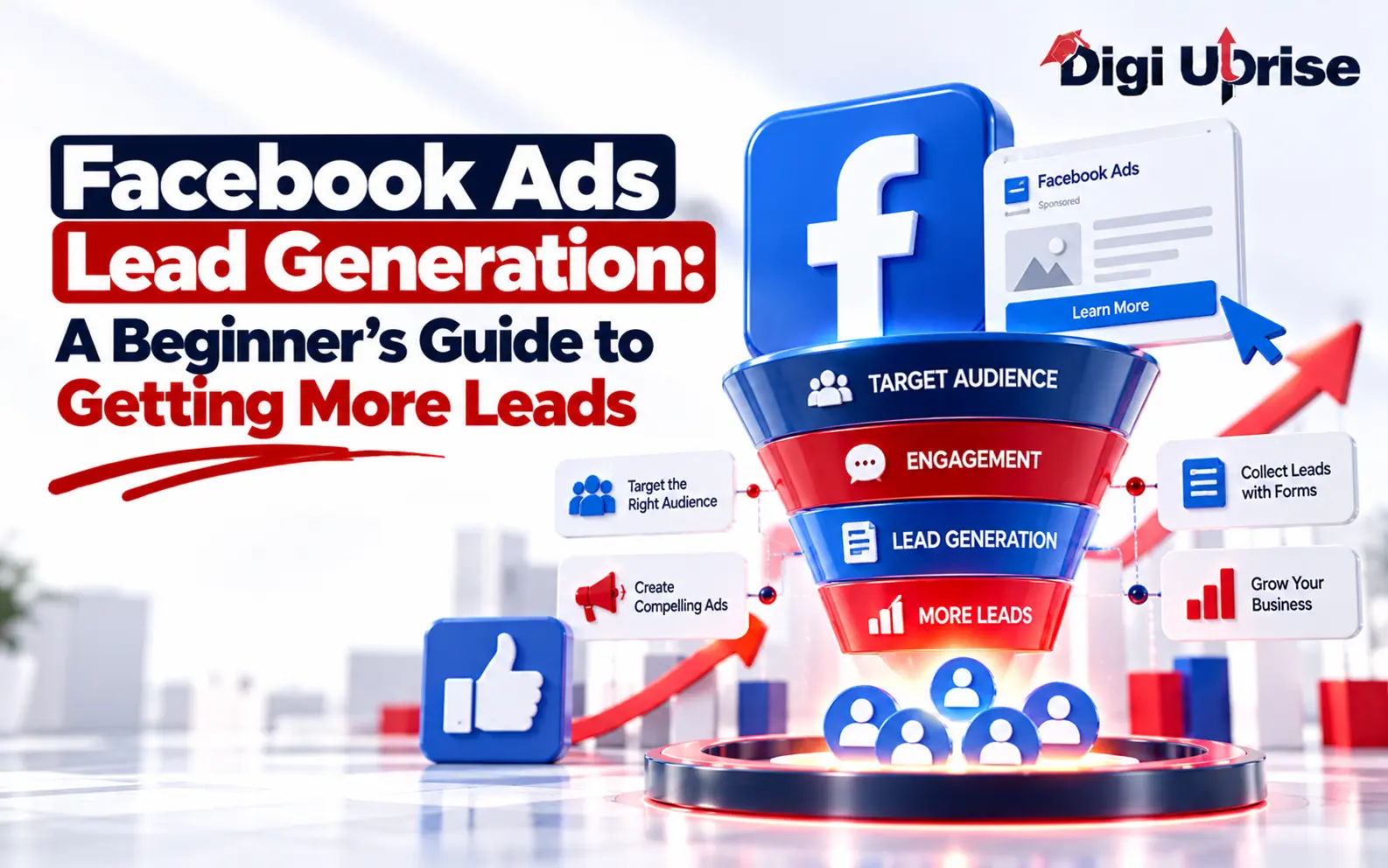
Facebook Ads Lead Generation: A Beginner’s Guide to Getting More Leads
Share with Friends :
Table of Contents
There’s satisfaction in getting likes and followers. But when it comes to growing a business, engagement alone doesn’t pay the bills.
What businesses really need are people who show genuine interest in their products or services. These potential customers are called leads, and Facebook Ads lead generation is one way businesses can attract them.
Whether you’re a student, job seeker, freelancer, or business owner exploring paid marketing, understanding how to generate leads using Facebook Ads can be valuable. A coaching institute can attract interested students, a gym can generate trial-class bookings, and a home baker can collect cake inquiries.
At Digi Uprise, a digital marketing institute in Delhi, learners explore how paid marketing, SEO, and content marketing work together to support business growth. Facebook advertising is an important part of this process, involving audience research, ad copywriting, creative development, budget management, and performance analysis.
In this guide, you’ll learn how Facebook lead generation works, how to set up a campaign, which best practices to follow, and how to measure advertising performance.
How to Generate Leads Using Facebook Ads
Lead generation is the process of attracting potential customers and collecting their contact details for follow-up.
Facebook Ads are created and managed using Meta’s advertising tools. These tools allow advertisers to reach relevant audiences based on factors such as location, age, interests, and behaviors, depending on the available targeting options. Depending on the campaign setup and available options, businesses can generate leads through Instant Forms, website forms, or supported messaging destinations such as Messenger, Instagram Direct, or WhatsApp.
Step-by-Step Guide to Generating Leads Using Facebook Ads
1. Define What Counts as a Lead
The first step you need to take before creating an ad is to define what a lead means for you. It depends on the type of business:
- The training institute needs leads for course inquiries
- The realtor needs leads for site visit requests
- The fitness club needs leads for a free trial booking
- The consultant needs leads for booked calls
All subsequent decisions depend on this definition, including your campaign objective, ad messaging, and lead form. Keep in mind that Meta frequently updates its interface and option names, so the steps in this guide may change over time.
2. Define Your Target Audience
When your ad feels tailored to a specific audience, it is more likely to capture attention. Start by identifying your ideal customer and understanding their needs.
For instance, the audience for a digital marketing institute can be:
- Final year students seeking a job after graduating
- Freshers wanting to work in marketing
- Professionals considering a career change
- Small business owners who want to promote their store online
Suppose Digi Uprise wants to attract students in Delhi who are interested in a digital marketing course. The ad offers a free course syllabus and a counselling call. After clicking the ad, students submit their names, mobile numbers, and preferred callback times. The admissions team then contacts them to answer questions and discuss enrollment.
The purpose of the lead campaign is not to gather the maximum number of phone numbers but the relevant ones.
Understand your audience’s needs, concerns, and decision-making factors before setting up your targeting. Next, configure the available audience settings, such as location and age, where applicable, to align with your campaign goals and target audience. Choose an audience that aligns with your offer instead of targeting people who are unlikely to become customers.
3. Choose How People Will Respond
It should be easy for them to proceed. Here are your choices:
Instant forms: Users can submit their contact details directly within Facebook or Instagram without visiting another website. This option offers a convenient mobile experience and is useful for collecting essential information from potential customers.
Landing pages: A landing page lets you provide additional information, answer potential customers’ questions, and build trust before collecting their contact details.
Messenger: Some potential customers may prefer to ask questions before sharing their details. A messaging destination allows them to initiate a conversation with your business.
Choose whatever suits the way your customers prefer to act.
4. Create an Ad That Captures Attention
People scroll quickly through their feeds, so your ad needs to capture attention immediately. Use a clear visual, concise messaging, and a compelling call to action.
An ad promoting a course could highlight topics such as SEO, social media marketing, paid advertising, and analytics, along with a clear invitation to request the course syllabus.
Some best practices include:
- Starting your ad with a question or problem recognized by your audience
- Clearly stating what your audience will receive from you
- Using short sentences
- Making the next step obvious
- Using different headlines and images
Don’t make any big promises either. Job guarantees, salary guarantees, and “get rich” statements hurt the credibility of your advertisement and may break Meta’s advertising policies. Be honest and use realistic examples to set clear expectations and attract more relevant leads.
5. Set Up Your Campaign in Meta Ads Manager
Follow these general steps to set up a Facebook Ads lead generation campaign:
- Log into Meta Ads Manager and create a new campaign.
- Select the Leads campaign objective when it aligns with your goal, then choose an available conversion location and performance goal that match how you want to collect leads.
- Choose where you want to collect leads, such as through an Instant Form, your website, or a supported messaging destination.
- Select audience, placements, schedule, and budget.
- Include ad copy, creative assets, and a call-to-action.
- Either choose or create your lead form.
- Include all the information about privacy and the destination URL.
- Review everything again and launch.
Review all campaign settings before publishing. An incorrect phone number, a broken link, or a form error can waste advertising spend and prevent potential customers from contacting you.
6. Create a Simple and Effective Lead Form
The form is like a conversation; don’t expect too much at once or people will simply walk away. At the same time, asking too little may attract casual inquiries from people who are unlikely to become customers.
For an inquiry on a course, something like this should be sufficient:
- Name
- Phone number or e-mail
- Preferred course
- Time for a callback
Ask only for what you need, explain what will be done with the information, and then look at your leads. Are most leads unlikely to become customers? Add a qualifying question. If too few people complete the form, consider shortening it.
7. Follow Up With Leads Quickly
This is where many lead generation campaigns lose potential customers: delayed or inconsistent follow-up.
Contact people quickly, using the channel they agreed to. Answer all the questions, provide everything that was asked for and explain further actions. For an institution it could be sending the curriculum and arranging a consultation.
Continue following up and track the results. How many leads responded, scheduled a consultation, or became customers? These metrics help you evaluate the effectiveness of your lead generation campaign.
Facebook Ads Lead Generation Strategy: Best Practices
A successful Facebook Ads lead generation strategy relies on consistent testing, relevant offers, audience research, and performance analysis.
- Make a proper offer. “Contact us” is not the right one. Make your audience interested: “Get the full syllabus and free counseling call” is an example. Whatever it is, it can be a consultation, demo, webinar, a free guide – it has to be relevant and explained clearly.
- Do A/B testing properly. Create two or three ad variations and test one major element at a time, such as the headline or image, so you can better understand which changes influence performance.
- Evaluate the quality of leads and not only the cost. Cheaper leads that won’t answer your calls can cost you more than expected. Evaluate how many leads responded to your offer, attended or bought something and then target the right audience again.
- Perform retargeting ads if it’s reasonable. Suppose someone visited your course page but didn’t ask anything yet. Then a retargeting ad which explains the syllabus might be useful. Perform retargeting based on your account settings, audience size and Meta’s policies on the issue.
How to Measure Facebook Ads Lead Generation Results
Campaign metrics help you evaluate whether your advertising budget is generating meaningful results. Here is the list of metrics that you should track:
Metric | Description |
Impressions | The number of times your ad was displayed. |
Click-through rate (CTR) | The percentage of impressions that resulted in clicks. |
Leads generated | The total number of leads collected. |
Cost per lead (CPL) | Total advertising spend divided by the number of leads generated. |
Conversion rate | The percentage of users who completed a specified action. |
Lead-to-customer rate | The percentage of leads who became customers. |
There is a simple formula for calculating cost per lead:
Cost per lead = Total advertising expenses ÷ Number of leads generated
If you allocate ₹5,000 in your budget and generate 40 leads, then the cost per lead will be ₹125. This number is just an example, as a decent cost per lead greatly depends on your industry and the goods and services that you sell. The key question is whether these leads convert into customers at a cost that makes business sense.
Facebook Ads and SEO: How They Work Together
Facebook Ads and SEO play different roles. Facebook Ads can provide paid visibility while a campaign is running, whereas SEO helps improve organic search visibility over time without requiring payment for every organic click.
In the case of an educational institution, Facebook Ads can promote free counselling sessions, while SEO-optimized blog posts can attract students searching for answers on Google.
Here is one more thing to consider: Google Search Console gives you an idea about the performance of your website in organic search, but does not show the performance of your Facebook ads. Use Meta Ads Manager to monitor Facebook Ads performance and Google Search Console to evaluate your website’s organic search performance.
Common Facebook Lead Generation Mistakes to Avoid
Being vague about the offer: If people do not understand what they will receive, they may continue scrolling without taking action.
- A long form. Additional form fields can reduce completion rates if they create unnecessary friction. Ask only for what is necessary.
- Lack of fast or any follow-up. The longer leads remain unattended, the more likely they are to lose interest. Also, the money spent on ads becomes waste.
- Hunting cheap leads. Cheap leads are often low-quality leads. Focus on the outcome.
- Never testing your ads. Your initial campaign is unlikely to be the most effective. Thus, make sure to constantly check the results and make adjustments.
Why Learning Facebook Ads Is Valuable for Beginners
Running lead generation campaigns helps you develop skills useful in many digital marketing roles, including audience research, ad copywriting, creative development, budget management, and performance analysis.
If you are a student or looking for a job, you will definitely benefit from practice. Sample projects and small-scale campaigns can help you demonstrate how you researched audiences, tested ad variations, managed budgets, and evaluated results. Often, the portfolio is more valuable than certificates.
Conclusion
Facebook Ads lead generation involves more than choosing an offer, setting a budget, and publishing an ad. Successful campaigns depend on understanding the target audience, creating a compelling offer, simplifying the conversion process, following up promptly, and measuring performance.
Work slowly. Do one campaign, analyze, and try improving one element after another. Eventually, you will gain insights into how your audience reacts. In digital marketing, this is one of the most valuable skills for novices.
When choosing a digital marketing course, consider the syllabus, the amount of practical work, the teaching approach, and the support provided. Digi Uprise, a digital marketing institute in Delhi, helps learners explore practical digital marketing skills.
Frequently Asked Questions
1. How do Facebook Ads create leads?
Facebook Ads generate leads by promoting an offer to a relevant audience and encouraging people to take action. Interested users can submit their contact details through an instant form, visit a landing page, or start a conversation through a supported messaging destination. Businesses can then follow up with these potential customers to answer questions and convert qualified leads into customers.
2. What are Facebook lead ads?
Facebook lead ads are advertising campaigns designed to collect information from potential customers. Depending on the campaign setup, users can submit their details through instant forms, visit a website landing page, or use other supported lead-generation destinations. Businesses use this information to follow up on inquiries, schedule consultations, and generate sales opportunities.
3. How much budget is needed for Facebook Ads lead generation?
There is no fixed budget that works for every Facebook Ads lead generation campaign. The required budget depends on factors such as your industry, target audience, competition, offer, and expected cost per lead. Start with a manageable testing budget, monitor the cost and quality of leads, and adjust your spending based on campaign performance.
4. Are Facebook Ads good for beginners?
Yes, Facebook Ads can be a useful starting point for beginners learning paid digital marketing. They provide practical experience in audience research, ad copywriting, creative development, budget management, and performance analysis. Beginners should start with a clear campaign objective, test different ad variations carefully, and evaluate results before increasing their budget.
5. How can I increase lead quality from Facebook Ads?
You can improve lead quality by creating a relevant offer, targeting an appropriate audience, and asking useful qualifying questions in your lead form. Follow up with leads promptly and track how many respond, qualify for your offer, book consultations, and become paying customers. Evaluating these outcomes alongside cost per lead helps you identify which campaigns deliver genuine business value.
6. What skills are needed to use Facebook Ads effectively?
Using Facebook Ads effectively requires skills in audience research, ad copywriting, creative development, budget management, and campaign analysis. You should also understand Meta Ads Manager, lead form optimization, conversion tracking, and applicable advertising and privacy policies. Practicing these skills through controlled campaigns helps beginners understand how to evaluate and improve performance.