- August 8, 2026
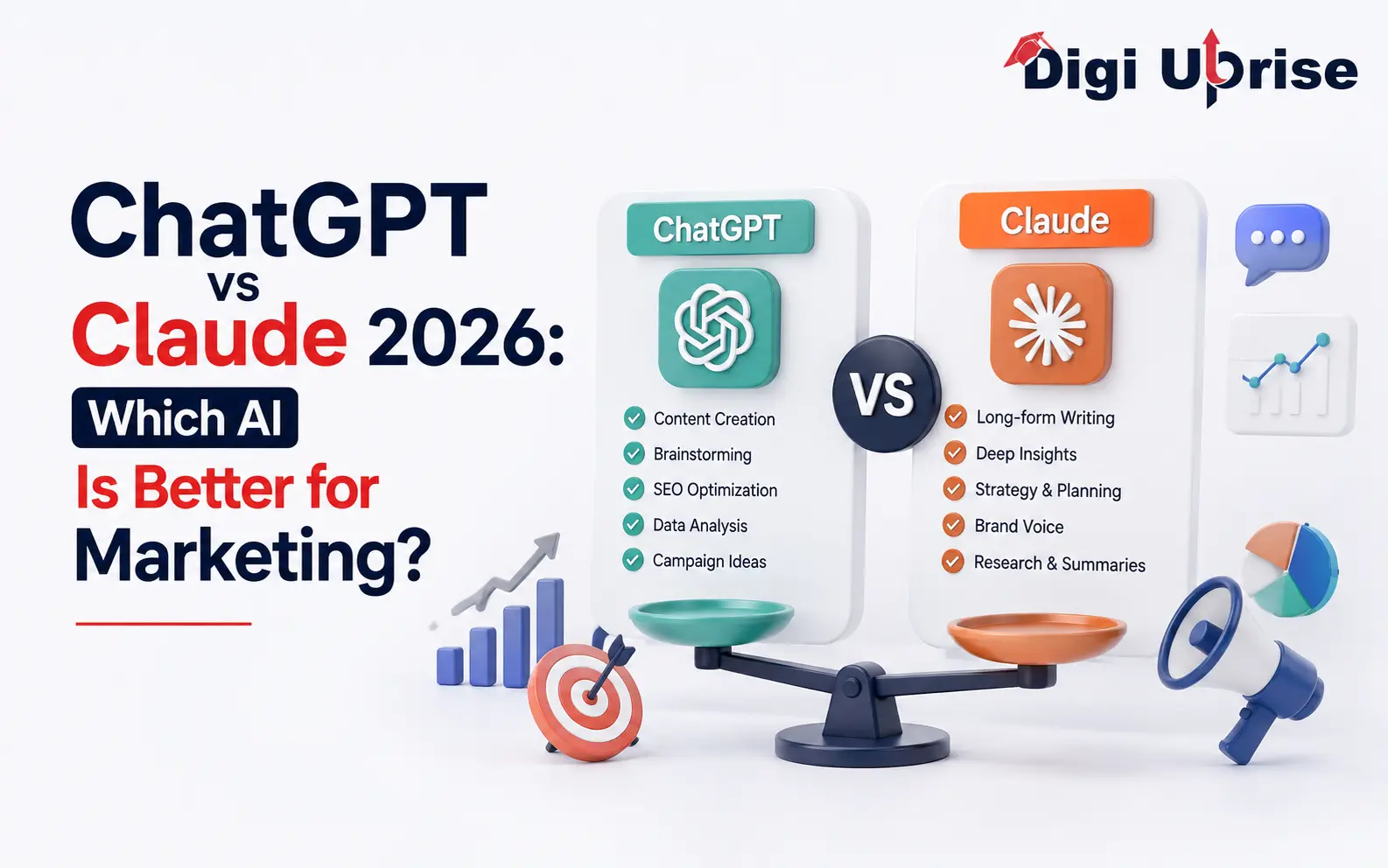
ChatGPT vs Claude 2026: Which AI Is Better for Marketing?
Share with Friends :

Table of Contents
AI has moved from a “nice to have” to a core part of how marketing teams operate. Campaign planning, content creation, ad copy, reporting, almost every workflow now touches an AI tool somewhere. Two names come up more than any others in that conversation: ChatGPT and Claude.
Both are capable, both are widely used, and both are frequently misunderstood as being basically the same thing. They’re not. Each tool has a different personality, a different set of strengths, and a different ideal use case, and knowing the difference can noticeably change how efficient your workflow is.
This guide breaks down ChatGPT vs Claude across the tasks marketers handle every day: SEO, content marketing, social media, paid advertising, and email, so you can decide which tool (or combination of tools) fits your team.
What Is ChatGPT?
ChatGPT is an AI conversational assistant built by OpenAI. It understands natural language and can hold a conversation, answer questions, generate content, brainstorm ideas, write and debug code, summarize information, and translate text. For marketers, its biggest appeal is speed, it’s very good at turning a rough idea into a usable first draft in seconds.
Common marketing uses:
- SEO blog content and outlines
- Website and product copy
- Social media captions and post ideas
- Google Ads headlines and descriptions
- Email marketing text
- Keyword and topic brainstorming
- Quick content calendars
Marketers tend to reach for ChatGPT when they need volume, a week’s worth of captions, ten ad variations, a batch of subject lines, and when the task rewards creative variety over deep precision.
What Is Claude?
Claude is an AI assistant built by Anthropic. It’s particularly well suited to complex reasoning, working with long documents, and producing detailed, carefully structured writing. Where ChatGPT often feels like a fast idea generator, Claude tends to feel more like a careful editor and analyst, it’s comfortable holding a lot of context at once and reasoning through it methodically.
Common marketing uses:
- Data analysis and campaign insights
- Marketing summaries and reports
- Brand guideline documentation
- Long-form write-ups and whitepapers
- Content review, editing, and proofreading
- Business plans and strategy documents
Marketers often bring Claude in later in the process, once there’s already a draft, a dataset, or a long document that needs to be reviewed, tightened, or made consistent.
ChatGPT vs Claude for SEO
SEO work usually happens in two phases: creating content, and refining it so it actually performs. The two tools map onto those phases fairly naturally.
ChatGPT for SEO is useful for:
- Content optimization suggestions
- First-draft blog posts
- Meta titles and descriptions
- Improving readability and tone
- Internal linking suggestions
- Building topic clusters and content pillars
Claude for SEO is useful for:
- Enhancing and tightening existing content
- Reviewing long-form articles for gaps
- Improving structure, headings, and flow
- Summarizing research or competitor content
- Clarifying and sharpening search intent
A workflow that works well for a lot of SEO teams: draft with ChatGPT to get ideas down fast, then hand the draft to Claude for a structural and clarity pass before publishing.
ChatGPT vs Claude for Content Marketing
Good content marketing needs three things at once: creativity, consistency, and accuracy. No single AI tool nails all three equally well, which is exactly why pairing them tends to work better than picking one.
ChatGPT is commonly used to create:
- Blog posts and articles
- Product and landing pages
- Video and reel scripts
- Social media posts
- Email newsletters
Its conversational tone tends to land well with audiences, and it’s fast enough to support high-volume content calendars without becoming a bottleneck.
Claude is commonly used to:
- Edit and polish long-form content
- Maintain a consistent brand voice across pieces
- Improve pacing and content flow
- Organize complex or technical information into something readable
In practice, ChatGPT output tends to feel more creative and varied straight out of the gate, while Claude is stronger at refining detailed content, catching inconsistencies, and making sure a 2,000-word piece still reads clearly from start to finish.
ChatGPT vs Claude for Social Media Marketing
Social media rewards two things above all: frequency and quality. Falling short on either one shows up quickly in engagement numbers.
ChatGPT helps marketers develop:
- Instagram and Facebook captions
- LinkedIn articles and thought-leadership posts
- Reel and short-video scripts
- Content calendars
- Hashtag research and ideas
Claude helps marketers with:
- Campaign planning across platforms
- Audience messaging strategy
- Brand voice and tone consistency
- Reviewing content before it goes live
A common pattern here: use ChatGPT to generate the bulk of the content, then run it through Claude as a final consistency check before scheduling.
ChatGPT vs Claude for Google Ads and Email Marketing
Ad copy has one job, get someone to act. Email has a slightly different job, building a relationship over time. Both benefit from AI, but in different ways.
ChatGPT can generate:
- Google Ads headlines and descriptions
- Landing page copy
- Call-to-action variations for A/B testing
- Email subject lines
- Promotional campaign copy
Claude can generate:
- Detailed, multi-step email sequences
- Brand-consistent promotional campaigns
- Customer nurture and lifecycle email flows
- Sales and outreach email drafts
- Full marketing strategy documents
- Campaign performance summaries and reports
If you need punchy, testable ad variations fast, ChatGPT is usually the quicker route. If you’re building out a full nurture sequence or a strategy document that needs to stay coherent across many steps, Claude tends to hold up better over the length of the task.
How to Choose Between Them
Task | Better Fit | Why |
First drafts & brainstorming | ChatGPT | Faster, more varied creative output |
Editing & polishing long content | Claude | Stronger at structure and nuance |
SEO blog drafts | ChatGPT | Quick, optimizable first drafts |
Content review & QA | Claude | Better at consistency checks |
Social captions | ChatGPT | High-volume, conversational tone |
Campaign strategy docs | Claude | Handles long, detailed documents well |
Ad copy | ChatGPT | Snappy, CTA-driven copy |
Email sequences | Claude | Strong for multi-step, structured flows |
If you can only use one tool, think about what most of your day actually looks like. If you’re constantly generating new content, captions, ad variations, blog drafts, ideas, ChatGPT’s speed will probably serve you better day to day. If your work leans toward reviewing, editing, reporting, or managing long documents and campaign strategy, Claude’s strength with structure and context will likely save you more time.
Most marketing teams don’t have to choose, though. The two tools complement each other well: one for output, one for refinement. A simple rule of thumb, generated with ChatGPT, refined with Claude, covers a surprising amount of a marketer’s weekly workload.
Conclusion
Neither tool is objectively “better.” They’re built around different strengths, and the right choice depends on the task in front of you. ChatGPT tends to lead in fast content generation across social media, ad copy, and SEO drafts. Claude tends to stand out in editing, planning, and working through longer or more complex documentation. Most marketing teams get the best results by using both, ChatGPT to generate, Claude to refine, rather than treating this as a competition with one winner.
Want hands-on training using AI tools like ChatGPT and Claude for SEO, Google Ads, and social media marketing? Explore Digi Uprise‘s digital marketing courses in Delhi or book a free consultation to find the right learning path for you.
Follow us on Instagram and Youtube for the latest digital marketing trends and student success stories.
Frequently Asked Questions
1. Will ChatGPT work for SEO?
Yes, it’s commonly used to draft SEO content, generate keyword and FAQ ideas, write meta descriptions, and put together blog outlines quickly.
2. Which AI tool is best for content writing?
ChatGPT is often preferred for creative, high-volume writing, while Claude is often preferred for reviewing, structuring, and analyzing longer-form content.
3. Can beginners learn to use AI tools for marketing?
Yes, most people can pick up the basics of both tools fairly quickly through hands-on practice with real marketing tasks like drafting posts, ads, and reports.
4. Do I need both tools, or just one?
It depends on your workflow, but many marketers get the best results using both, one for drafting, one for refining, rather than relying on a single tool for everything.
5. Which tool is better for reporting and campaign summaries?
Claude tends to be the stronger fit here, since it’s built to work well with longer documents and can hold more context while summarizing performance data or campaign results.