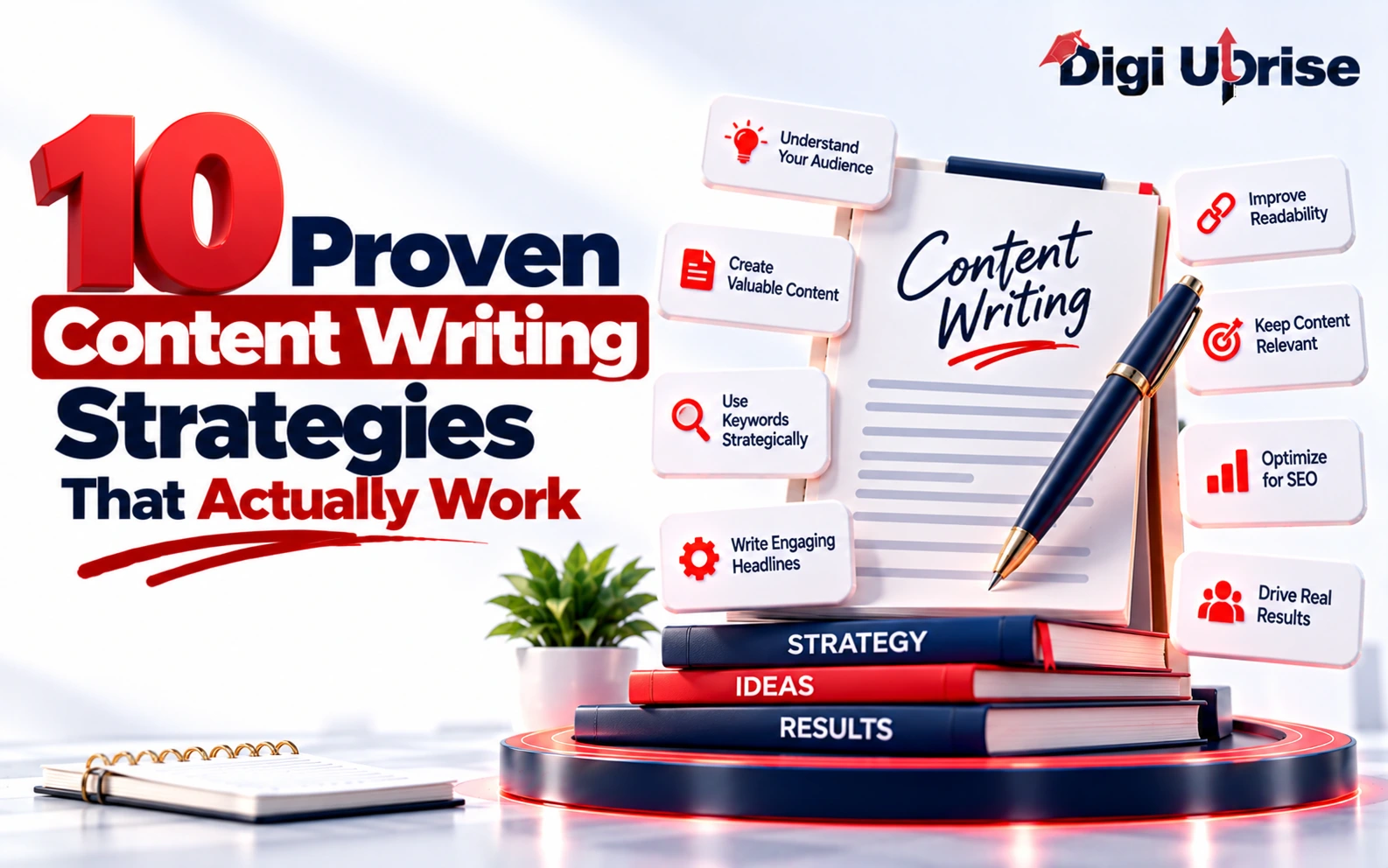
10 Proven Content Writing Strategies That Actually Work
Share with Friends :

Table of Contents
Content writing strategies help writers create useful, engaging, and search-friendly articles that meet readers needs. Effective content writing requires understanding search intent, researching relevant keywords, structuring information clearly, and using AI tools responsibly. These 10 proven content writing strategies will help you improve readability, optimize your articles for SEO, and measure content performance.
From audience research and content planning to on-page SEO and performance analysis, each strategy focuses on practical steps you can apply to your next article.
Quick Answer: The best content writing strategies are to know your audience, target the right keywords, fill content gaps, outline before writing, craft clear headlines, edit for clarity, optimize for SEO, use AI responsibly, track performance, and follow a consistent workflow.
1. Understand Your Target Audience
The first step in writing an effective article is understanding your readers. Before you begin writing, you need to know who your readers are, how they will benefit from the information, and how it can help them solve their problems.
For example, a teacher searching for content writing tips may want classroom activities or exercises for students. Someone searching for SEO meta description tips may want examples, recommended character lengths, and practical optimization advice. Understanding these different needs helps writers create content that matches search intent.
When content matches the readers needs, it is easier to write relevant introductions, headings, examples and calls to action.
2. Research Keywords and Topics Strategically
Keyword research can help content writers better understand the language their audience uses to search for information. Focusing only on high-search-volume keywords can lead writers to create content that ultimately attracts an irrelevant audience.
Identify Relevant Keywords and Questions
Consider Google Search Console and other keyword research platforms as resources to find related questions and topics. Assess the keyword relevance, competition and intent to identify your primary keyword.
For example, instead of targeting the broad phrase “content writing,” explore more specific queries such as “how to write SEO-friendly blog posts” or “content writing tips for beginners.” Choose keywords based on search intent, relevance to your audience, and the value your article can provide.
Choose topics that address your audience’s questions, solve relevant problems, and provide practical value.
Use keyword variations in a manner that will help your audience understand what you are trying to communicate.
3. Analyze Competitors and Identify Content Gaps
Review relevant competing articles to identify unanswered questions, unclear explanations, outdated information, and missing practical examples. Use these gaps to develop a more useful article with original insights, verified information, and examples that help readers apply what they learn.
Craft Unique Content
Use your own example or create a useful resource to help the reader understand the information and apply it.
For example, if competing articles explain keyword research without showing how to evaluate a query, include a practical example that considers search intent, audience relevance, and the usefulness of the proposed content.
The goal is to write something useful and comprehensive. If an article provides the same info as competitors’ articles, but is longer, that doesn’t make it higher quality.
4. Create a Clear Content Outline
An unclear content structure can lead to repetition, disconnected paragraphs, and confusing transitions. A well-planned outline helps you organize information logically and guide readers from one idea to the next.
Put Major Sections in the Correct Order
Put the main idea at the top, and the sections that support that idea in the following order. Use H2 for main ideas, and H3 for subtopics.
For an SEO content writing article, your outline might cover audience research, keyword selection, content structure, on-page optimization, editing, and performance measurement.
Be sure to give every section a purpose. Before writing, review your outline to make sure two ideas that cover the same idea are in the same section and combine or remove them as appropriate.
5. Write Clear Headlines and Engaging Introductions
Your headline must capture what the article is about and motivate the reader to learn more. Don’t promise the reader something the article cannot deliver.
Be as Specific as Possible With Your Headlines
A generic headline such as “Content Writing Tips” gives readers little information about the article. A more specific headline, such as “7 Content Writing Tips to Create More Engaging Blog Posts,” communicates the topic and the benefit more clearly. Choose a title that accurately reflects the content and matches the reader’s search intent.
The introduction should clearly state the topic and main idea of the article. Don’t include excessive background information that makes the reader wait too long to get the answer.
The introductory paragraph should contain enough details to help potential readers determine whether the article is worth their time.
6. Edit for Clarity
Writing should not impede understanding of the material, and explanations should not be longer than they need to be. Describe main points, incorporate examples, and use headings where appropriate to help clarify new or difficult ideas.
To eliminate long, complicated, or awkward phrases, replace them with clear, concise language. You may need to adjust sentence length, paragraph length, and overall structure to do this.
Reading the draft aloud can help you spot long or awkward phrases.
Include lists or tables to help illustrate complicated ideas.
7. Write for SEO
SEO content writing involves creating useful, relevant content that meets readers’ needs and is easy for search engines to discover and understand. Along with using relevant keywords naturally, focus on search intent, clear headings, descriptive metadata, helpful internal links, and accurate information. These practices support search visibility, but they do not guarantee higher rankings.
Include your primary keyword in the title, heading, and main sections where they are most pertinent. Related words and phrases can be used where appropriate to help explain the main point.
Write a title and meta description that accurately and enticingly describe your page. Logically organize your headings and add relevant internal links to help readers find other content on your site.
External links to trustworthy sources can help readers learn more and support claims.
An article about keyword research could link to a trustworthy source on search intent or on-page SEO to add value for the reader. Each of your links should be valuable to the reader.
For additional guidance, review Google’s official SEO Starter Guide to learn how to make website content easier for search engines to discover and understand.
8. Use AI Tools Responsibly in Content Writing
AI writing tools can help content writers brainstorm ideas, organize outlines, identify potential content gaps, and improve drafts. However, their suggestions should be reviewed for accuracy, relevance, originality, and alignment with the reader’s needs.
Treat AI-generated suggestions as a starting point, not as a substitute for independent research, fact-checking, and editorial judgment.
AI-generated content can contain inaccurate claims, outdated information, or unsupported statements. Verify important facts against reliable sources before publishing.
You must be the final judge of the content. Always verify the factual claims and check the sources. Remove opinions or generic statements. Provide relevant examples. To ensure you’ve communicated your points accurately, ask yourself whether you answered the reader’s question.
At Digi Uprise, aspiring marketers can learn how to use AI tools as part of a practical content marketing workflow, including research, drafting, optimization, and content review.
9. Measure Content Performance and Make Improvements
There’s still work to do after an article is released. Monitoring performance can help you understand whether it reaches the target audience and where it may need revision.
Base Decisions on Performance Data
Google Search Console provides data on search queries, impressions, clicks, and click-through rates. This data can identify useful queries and relevant pages.
If Google Search Console shows that an article receives impressions for a relevant search query that the content does not adequately answer, consider adding a clear and useful explanation. If a page receives impressions but has a low click-through rate, review its title and meta description alongside the search intent and competing results. Use performance data to identify potential improvements rather than assuming a single cause.
Prioritize updates based on relevant performance data, search intent, and the purpose of each page. Review conversion data separately when evaluating whether content contributes to business goals, and avoid making changes without a clear reason.
10. Establish a Consistent Writing Workflow
A consistent content writing workflow helps writers manage deadlines, maintain quality, and reduce the risk of missing important publishing steps. Establish a repeatable process for research, outlining, drafting, editing, SEO checks, and performance review.
A consistent workflow should ensure that:
- Appropriate metadata and internal links are used.
- Content provides a clear next step for readers when appropriate.
Update articles when information becomes outdated and/or readers require further clarification.
Consistency doesn’t necessarily mean publishing frequently. It means maintaining a reliable standard for content quality.
Conclusion: Apply These Proven Content Writing Strategies
Effective content writing combines audience research, original insights, clear organization, and thoughtful SEO. By applying these 10 content writing strategies, writers can create useful articles that meet search intent, improve readability, and support search visibility. Regularly review published content and update it when new information or performance data identifies a meaningful opportunity for improvement.
Writers and aspiring marketers can develop their SEO and content marketing skills through practical learning at Digi Uprise. Apply these content writing strategies to your next article and use performance data to identify opportunities for improvement.
Frequently Asked Questions
1. How Can Content Writers Improve Their SEO Writing Skills?
Content writers can improve their SEO writing skills by researching search intent, choosing relevant keywords, organizing headings logically, writing descriptive metadata, and adding useful internal links. They can also use Google Search Console to review impressions, clicks, click-through rates, and search queries, then update content based on relevant performance data.
2. How Is AI Changing Content Writing?
AI tools can help content writers brainstorm ideas, organize outlines, research topics, and edit drafts. However, writers must verify facts, evaluate sources, add original insights, and ensure the final article meets the audience’s needs. Human editorial judgment remains important for accuracy, relevance, and usefulness.
3. What Makes Content High-Quality and Useful for Readers?
High-quality content answers the reader’s question accurately and clearly, uses language appropriate for the intended audience, and provides relevant information or original insights. It should be well-structured, trustworthy, and useful enough to help readers understand a topic or take their next step.
4. How Often Should Content Writers Update Published Articles?
There is no set schedule for article updates. Content should be updated when new, relevant information is made available, or to correct broken links and outdated performance data. Content should be meaningfully updated to reflect improvements to the quality and relevance of the information.