- August 31, 2026
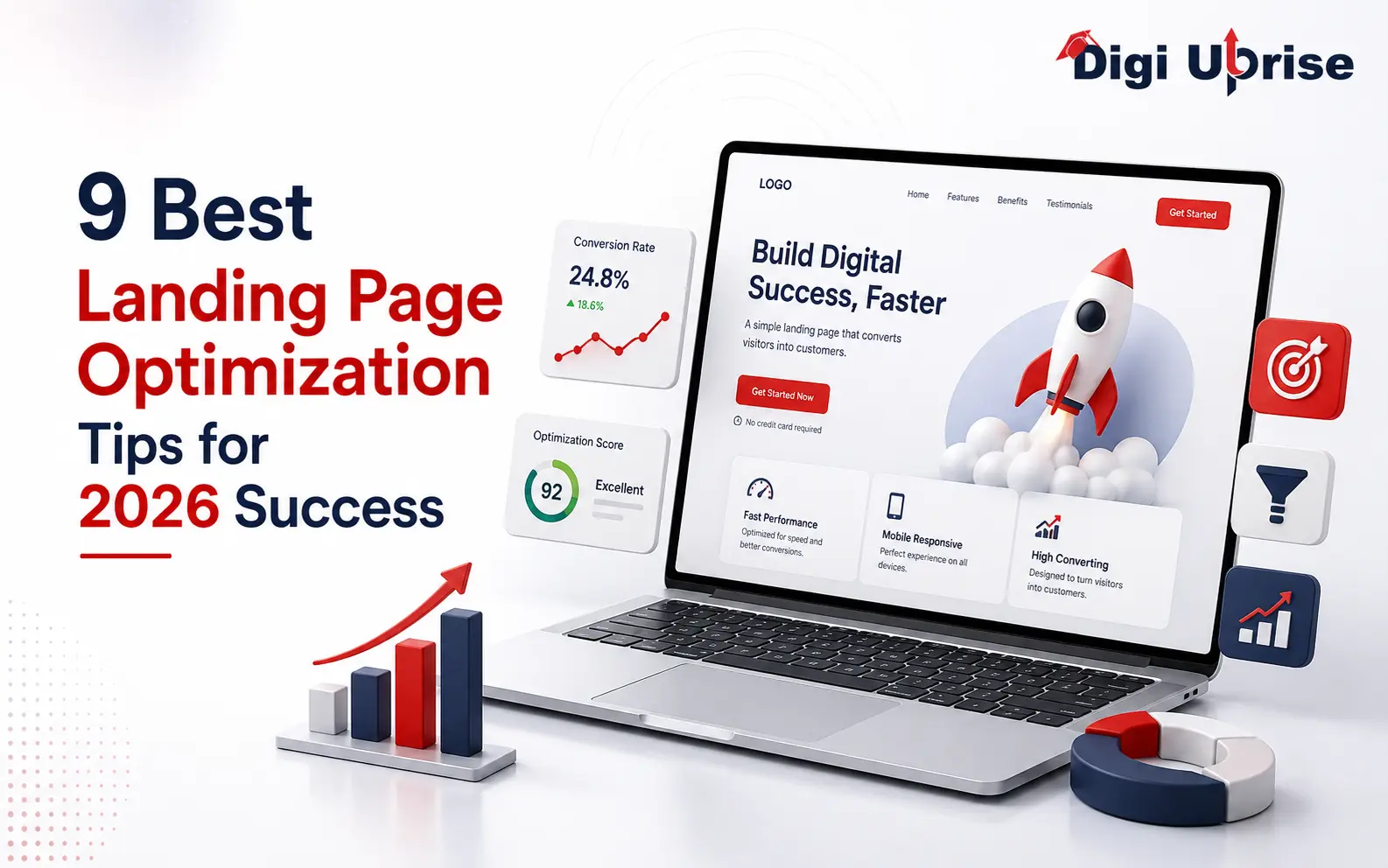
9 Best Landing Page Optimization Tips for 2026 Success
Share with Friends :
Table of Contents
Is your landing page getting plenty of visitors but surprisingly few conversions? Do people click through to your page from your advertising, but then don’t go any further and don’t convert?
The problem may not be your traffic. It could be your landing page.
A well-optimized landing page can turn existing traffic into more leads, enquiries, and sales by making the visitor journey clearer and more persuasive. In this guide, we’ll explore 9 practical landing page optimization tips to help you reduce friction, strengthen your messaging, improve user experience, and increase conversions in 2026.
What Is Landing Page Optimization?
Landing page optimization is the process of improving a webpage to encourage visitors to complete a specific action. This could be submitting a form, purchasing a product, booking a consultation, downloading a resource, or signing up for a course.
Getting visitors to a page is only one part of digital marketing. If visitors cannot understand the offer or quickly find the next step, valuable traffic can be lost.
For example, a digital marketing institute may run Google Ads for a course. If the advertisement promises practical training but the landing page has a vague headline and several unrelated offers, visitors may leave without enquiring.
A focused page connects visitor intent with one clear action.
9 Landing Page Optimization Tips for Better Conversions
These landing page tips cover the elements that can directly influence visitor decisions.
1. Create an Effective and Benefit-Focused Headline
The headline must effectively tell the reader what is on offer and the importance of that offer.
Instead of writing :
Digital Marketing Course
Try:
Learn Practical Digital Marketing Skills for Your Future Career
The latter headline provides a clearer-cut benefit statement.
2. Create One Strong Call-to-Action
Every landing page should have a clear primary goal.
Useful CTA examples include:
- Get Course Details
- Book a Free Consultation
- Start Your Free Trial
- Enquire Now
Too many competing links and offers can distract visitors from the main action.
Your CTA should also make it clear what happens after the click.
3. Match the Landing Page With Your Ad
Your landing page should continue the message visitors saw in your advertisement.
For example, if your Google Ad says “Learn Google Ads From Beginner to Advanced,” the landing page should immediately reinforce that promise.
If visitors instead see a generic page covering multiple services, they may question whether they reached the correct page.
Matching the headline, offer, keywords, and CTA with the traffic source creates a more consistent user journey.
4. Keep Lead Forms Simple
A complicated form can make interested visitors leave before submitting their details.
- Ask only for essential information such as name, phone number, and email.
- Remove unnecessary fields that do not help with the immediate sales or enquiry process.
- Use clear field labels so visitors know exactly what information to enter.
- Add a clear submit button such as “Get Course Details” instead of a generic “Submit.”
5. Use Trust Signals and Social Proof
Visitors may hesitate when they are unfamiliar with your business.
Some useful trust signals are as follows:
- Genuine customer reviews
- Testimonials from students
- Case studies
- Certifications
- Client results
- Clear contact information
For a digital marketing institute, authentic student experiences and course outcomes can help prospective learners feel more confident.
Don’t resort to making up fake testimonials or making false claims.
You should earn trust by giving true-to-life facts that will be believable and verifiable for your visitors.
6. Optimize for Mobile Users
Your landing page should work smoothly across smartphones, tablets, and desktops. Responsive design is a basic requirement for effective landing pages.
Check that:
- Text is easy to read
- Buttons are simple to tap
- All forms function properly
- Images display properly
- The call-to-action is visible
- Users do not need horizontal scrolling
Always test the page on real mobile devices before launching a campaign.
7. Improve Landing Page Speed
Poor page performance may prevent people from engaging even before they become aware of the offer.
Some of the reasons behind slow speed include big images, unnecessary scripts, unnecessary animations, and underoptimized website components.
How to increase page speed:
- Minimize image sizes.
- Eliminate unnecessary scripts.
- Eliminate excessive animations.
- Utilize caching.
- Monitor Core Web Vitals.
- Check mobile page load speed.
Speed should be considered part of both user experience and conversion optimization. Current 2026 guidance continues to highlight page performance as an important landing-page factor.
8. Include Appropriate Images and Visuals
Visuals can communicate an offer more quickly than large paragraphs.
For example, an online digital marketing course page could include visuals of students creating campaigns, utilizing analytics, attending training classes, and doing practical assignments.
The visual elements should be those that support the real offer instead of generic pictures.
A good image would help answer questions, convey benefits, or build credibility.
9. A/B Test Different Page Elements
You cannot always predict which version will perform better. A/B testing allows you to compare different versions using actual visitor data.
You can test:
Element | Version A | Version B |
Headline | Learn Digital Marketing | Build Job-Ready Skills |
CTA | Submit | Get Course Details |
Form | 6 fields | 3 fields |
Image | Classroom | Student working |
Test meaningful changes, collect enough data, and use the results to guide future improvements. A/B testing remains an important part of conversion optimization in 2026.
How to Optimize a Landing Page Step by Step?
The best way to optimize a landing page is to follow a clear process rather than making random design changes.
Start With One Conversion Goal
Decide what you want visitors to do:
- Generate a lead
- Buy a product
- Register for an event
- Book an appointment
- Download a resource
A page designed for course enquiries will have a different structure from an ecommerce product page.
Understand Visitor Intent
Consider what the visitor wants to know before taking any actions.
For example, the prospective student will ask questions like:
- What will I learn?
- Is there practical training?
- Who can join?
- How long does the program take?
- What support is available?
Provide answers to these questions without bombarding the visitor.
Remove Conversion Barriers
Look for problems such as slow loading, confusing navigation, weak CTAs, lengthy forms, or missing trust information.
Fix the biggest barriers first and then measure the results.
Which Landing Page Elements Should You Measure?
Landing page optimization requires data. Useful metrics include:
Metric | What It Shows |
Conversion Rate | Visitors completing the goal |
CTA Click Rate | Visitors interacting with the CTA |
Form Completion | Visitors finishing the form |
Bounce Rate | Visitors leaving the page |
Page Speed | How quickly the page loads |
Cost Per Lead | Cost of acquiring each lead |
In case there are 1,000 visits, and 50 fill out a form, then the conversion rate would be 5%.
It is important not to evaluate the performance of the landing page only on the basis of one factor.
Conclusion
Landing page optimization means providing the visitor with clarity regarding what it is that you are offering them. This would be done through various elements.
At Digi Uprise, these practical digital marketing concepts can help students and aspiring marketers understand how better website experiences can support stronger marketing results.
Looking for even more tips on how to implement them practically? Subscribe to Digi Uprise on YouTube and Instagram for all sorts of tips related to digital marketing, insights, and learning.
Frequently Asked Questions
1. What are the key features of a good landing page?
A good landing page will be able to communicate the offer effectively, fulfil the visitor’s intentions, build trust, and facilitate the required action.
2. Should a landing page include pricing?
Depends on the offer, target audience, and sales process. Showing pricing can build transparency, while hiding it may encourage prospects to contact your sales team.
3. How much content should a landing page have?
There is no fixed word count. Simple offers may need less content, while complex or expensive offers may require additional information, proof, and FAQs.
4. Does video have a place on a landing page?
Yes. The appropriate video may show the value of a product, help to explain a service, answer frequently asked questions, or build trust. It must work towards conversion without slowing down the page.
5. When should landing pages be optimized?
Landing pages need to be optimized on an ongoing basis. This involves analyzing the performance of the page and making necessary improvements as needed.