
- August 27, 2026
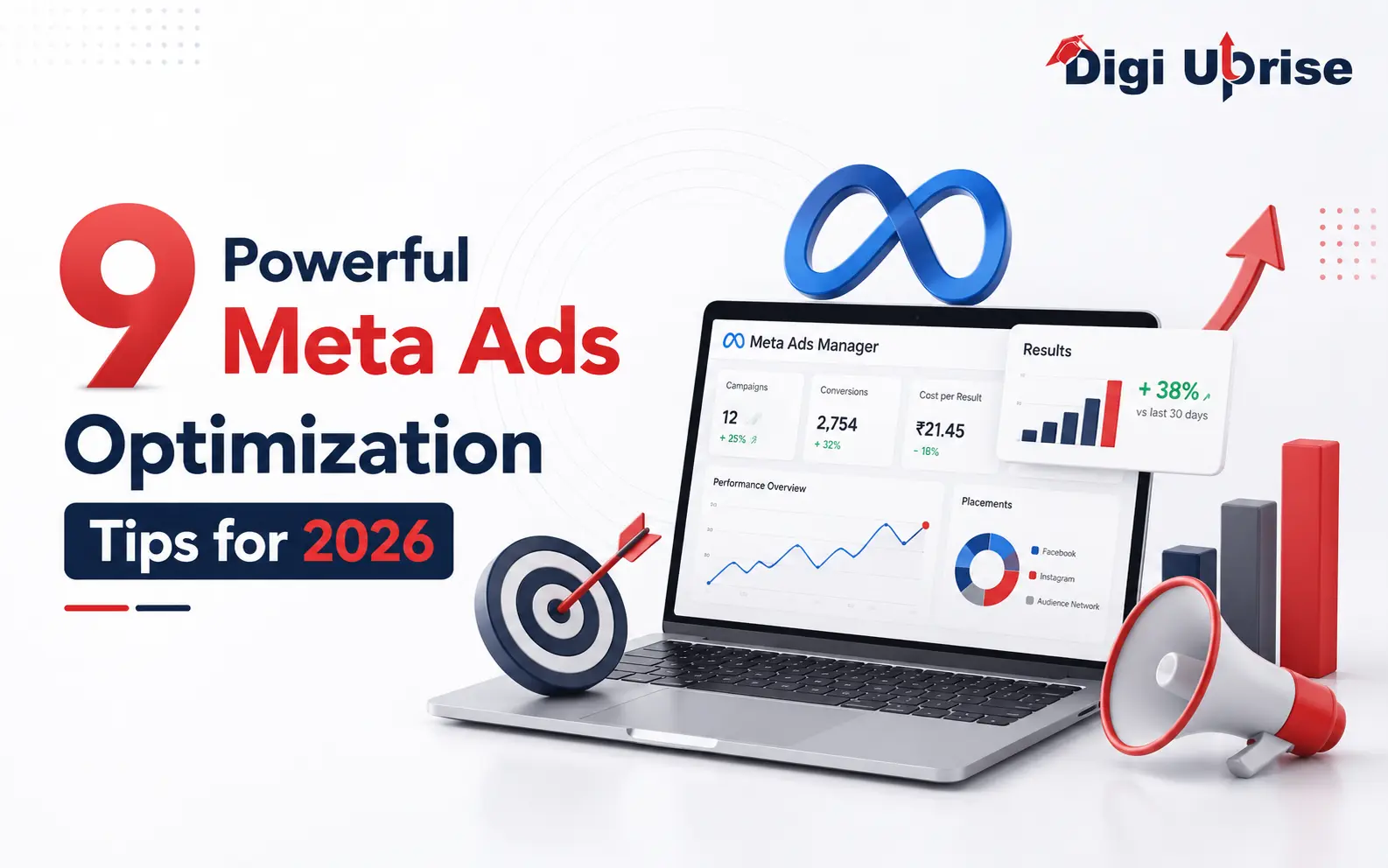
9 Powerful Meta Ads Optimization Tips for 2026
Share with Friends :
Table of Contents
Are you struggling with Meta Ads optimization despite spending consistently on campaigns?
The right Meta Ads campaign optimization can improve targeting, conversions, and return on ad spend without simply increasing your budget.
In this guide, we cover practical Meta Ads optimization strategies, testing methods, and campaign techniques that can improve your advertising performance in 2026.
What Is Meta Ads Optimization?
Meta Ads optimization means improving your campaigns using actual performance data. It involves reviewing your audience, creatives, budget, campaign objective, placements, and conversion data to identify what is working and what needs improvement.
Meta Ads need to be considered in a larger context of digital marketing. A company may employ SEO techniques for generating organic traffic, utilize social media for networking, and employ Meta Ads for rapid audience targeting.
For example, a digital marketing institute could attract students through organic search using SEO, educate them through social media content, and then use Meta Ads to promote a course to people who have already interacted with the brand.
Metric | What It Shows |
CTR | How effectively an ad attracts attention |
CPC | Average cost of a click |
CPL | Cost of generating a lead |
CPA | Cost of acquiring a conversion |
ROAS | Revenue generated from advertising |
Frequency | How often people see an ad |
Your Meta Ads strategy should focus on the metrics that directly connect to your campaign objective.
9 Meta Ads Optimization Strategies
The best Meta Ads optimization strategies focus on testing, measurement, and controlled improvements rather than making random changes.
1. Choose the Right Campaign Objective
Start by identifying what you actually want users to do.
If your goal is lead generation, your campaign should be designed around generating leads. If you sell products online, sales and purchase-related outcomes may be more important.
For example, a digital marketing institute looking for student enquiries should not judge success only by website traffic. Lead volume, lead quality, and cost per lead are more useful indicators.
Your campaign objective should also fit your overall Meta Ads strategy and the stage of the customer journey you want to target.
2. Create Better Ad Creatives
Your creative is one of the first things users notice while scrolling through Facebook and Instagram.
Test different:
- Video and image formats
- Hooks and headlines
- Offers
- Calls to action
- Testimonials
- Educational content
After testing, identify the creative concepts generating meaningful results and develop new variations around them.
This is where content marketing can support paid advertising. Blog articles, educational videos, guides, and social posts can provide ideas for advertisements.
For example, a blog explaining common SEO mistakes could be converted into a short video ad targeting business owners interested in improving their online presence.
Strong creatives should attract attention quickly, communicate the benefit clearly, and give users a reason to take action.
3. Improve Audience Targeting
Audience selection plays an important role in Meta Ads campaign optimization.
You can test broad audiences, interest-based targeting, Custom Audiences, Lookalike Audiences, and other available targeting approaches.
For example, a digital marketing institute could compare:
| Audience | Purpose |
| Marketing interests | Reach people interested in marketing |
| Website visitors | Retarget previous visitors |
| Social media engagers | Reach people familiar with the brand |
| Lookalike audience | Find users similar to existing customers |
Your social media marketing activity can support Meta Ads by building an audience of people who have already interacted with your content.
For instance, someone who watches several educational Reels may later be shown a relevant course advertisement. This creates a connection between organic social activity and paid advertising.
4. Track the Right Metrics
Don’t optimize a campaign simply because its CPC is low.
A campaign with a ₹5 CPC can be less valuable than one with a ₹10 CPC if the second campaign generates significantly more qualified leads.
Measure key performance indicators based on your goal:
Lead Generation: CPL, lead quality, conversion rate
E-commerce: CPA, purchases, ROAS
Traffic: CTR, CPC, Landing Page Performance
These KPIs become very crucial for performance marketing because all decisions are made on the basis of these results.
For example, if an advertisement receives thousands of clicks but generates very few enquiries, reducing CPC alone will not solve the problem. You need to investigate the landing page, offer, audience, and conversion process.
5. Test Your Budgets Wisely
Changes to budgets should always be based on consistent performance and not the result of a single good or poor day.
For example, let’s say that Campaign A delivers leads for your desired CPL while Campaign B delivers high-cost leads. Rather than adding the same amount to both, focus more on the successful campaign.
A simple approach is:
- Identify consistent performers.
- Compare them against your target KPI.
- Increase investment gradually.
- Monitor performance after the change.
- Adjust again based on the new data.
Meta Ads can also work alongside Google Ads. While both are paid advertising channels, user intent and targeting opportunities can differ. Businesses may use both to reach potential customers at different points in the buying journey.
6. Run Structured A/B Tests
A/B testing helps you understand what influences campaign performance.
Instead of changing your audience, creative, headline, and offer at the same time, test one important variable.
For example:
Ad A: Student testimonial
Ad B: Instructor-led educational video
If Ad B produces better results, you have useful information for your next creative test.
Influencer marketing can also provide creative inspiration. Creator-style videos, testimonials, product demonstrations, and authentic reviews can be adapted into Meta Ads when they fit the brand and audience.
Structured testing makes your Meta Ads optimization process more reliable because you can identify which changes are actually influencing results.
7. Watch for Creative Fatigue
The repetition of an advertisement by the same target group of viewers makes it ineffective, even when it is successful.
Look out for:
- Declining CTR
- Increasing CPC
- Rising CPA
- Lower engagement
- Increasing frequency
When the campaign shows reduced performance, try to bring in new creative ideas before declaring the whole campaign a failure.
Your social media marketing content can provide a continuous source of new creative ideas. Reels, customer stories, educational posts, and behind-the-scenes content can all be adapted into different advertising formats.
This also prevents your campaigns from relying on one creative for an extended period.
8. Check Your Conversion Tracking
Good optimization depends on reliable data.
Before making major campaign decisions, check your Meta Pixel, conversion events, Events Manager, and Conversions API where applicable.
Imagine a business receives 25 genuine leads but Meta records only 15. The advertiser could mistakenly believe that the campaign is underperforming and pause it.
Proper tracking will ensure you know whether your campaigns are really generating any impact.
This will also help you in comparing your paid ads with other acquisition sources like SEO and social media.
9. Scale What Works
When you figure out a campaign, audience, or creatives that work for you consistently, start scaling it gradually.
Like this:
₹1,000/day → consistent results → gradual scaling → monitor CPA/ROAS → continue if performance remains good
Scaling does not necessarily have to be an immediate doubling of your budget.
Scaling with Meta Ads requires a good ad strategy to maintain campaign efficiency as well as look out for profitable prospects. If scaling doesn’t work, analyze your audience, creative wear-out, conversion rate, and acquisition cost.
How to Build a Better Meta Ads Strategy?
Meta Ads campaign optimization works best when your campaign has a clear structure from the beginning.
Use this simple framework:
| Stage | What to Do |
| Goal | Define the business objective |
| Audience | Identify potential customers |
| Creative | Test multiple concepts |
| Campaign | Select the appropriate objective |
| Tracking | Verify conversion events |
| Testing | Compare different variables |
| Optimization | Improve weak areas |
| Scaling | Increase investment in winners |
For example, if your CTR is strong but your leads are expensive, don’t immediately change the audience. Check the landing page, offer, lead form, and conversion process first.
A full-fledged digital marketing strategy may incorporate paid advertisements along with SEO, social media marketing, email marketing, and content marketing. Each of these channels can be used to promote different stages of the customer journey.
Conclusion
Meta Ads optimization requires a never-ending process of testing, analyzing, and optimizing. Successful Meta Ads optimization implies the use of relevant audiences, powerful creatives, right tracking, and budget control.
Digi Uprise helps learners develop practical skills across Meta Ads, SEO, social media marketing, influencer marketing, and other areas of digital marketing.
Follow Digi Uprise on Instagram and YouTube for practical digital marketing tips, Meta Ads strategies, SEO insights, social media updates, expert guidance, and the latest industry trends.
Frequently Asked Questions
1. What can you do to optimize Meta Ads performance?
By optimizing Meta Ads, you can make improvements in targeting, creative testing, metrics monitoring, and conversion tracking, which will result in improved performance of your campaigns. Your main goal should be to make changes based on data that will improve leads/sales/ROAS.
2. How can Meta Ads campaign optimization help to improve performance?
Campaign optimization is useful because it helps identify weak spots in audiences, creatives, or conversions and make necessary changes. With regular testing, you can get better CTR, CPL, CPA, and ROAS.
3. What are the best Meta Ads optimization tactics?
The best tactics for Meta Ads optimization include testing various creatives, improving audience targeting, monitoring campaign metrics, verifying conversion tracking, managing budgets, and scaling good campaigns.
4. How do you create an effective Meta Ads strategy?
A good strategy for Meta Ads begins with the formulation of a campaign goal and an audience. It should also include appropriate creatives, tracking, testing, and performance monitoring.
5. How often should Meta Ads optimization be done?
Meta Ads optimization should be performed regularly, but campaigns should not be changed unnecessarily every day. Analyze meaningful performance trends and make changes when the data indicates a clear problem or opportunity.