
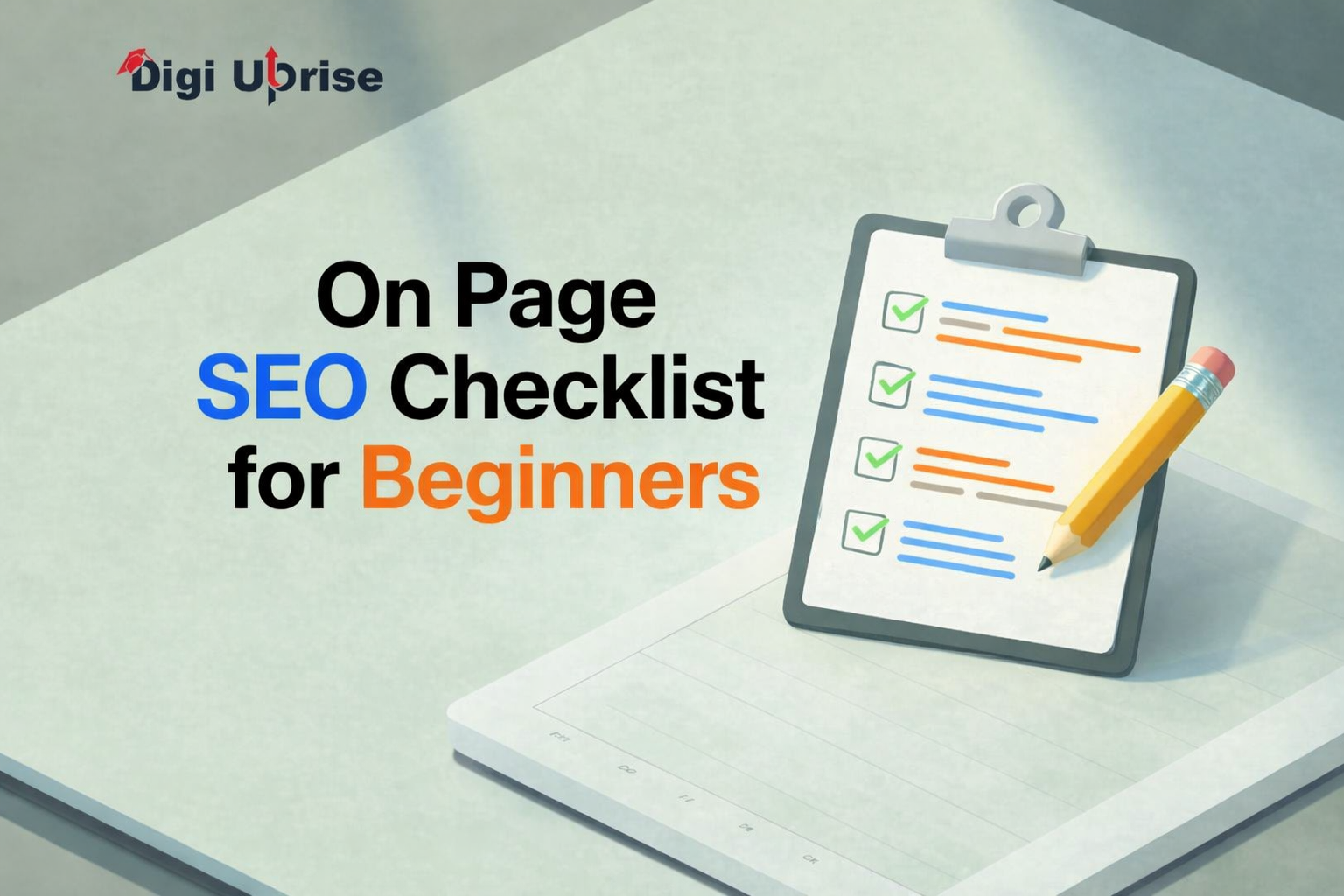
7 On Page SEO Checklist for Beginners
Share with Friends :

Table of Contents
- What is On Page Search Engine Optimization?
- Why is it Important to use an On Page SEO Checklist?
- Keyword Optimization Checklist
- Title Tag and Meta Description Optimisation
- Proper use of headings (H1,H2,H3)
- Readability and content quality
- Internal linking and image optimization
- Conclusion
- Frequently Asked Questions
Are you optimizing your website pages properly? Some beginners struggle to rank in Google’s search results when they create websites and blogs, but miss out on basic SEO steps. SEO is more than just writing content. Each webpage requires proper keyword placement, internal links, and headings. A structured on page SEO checklist is very useful in this situation.
As part of Digi Uprise‘s digital marketing program, students are taught SEO strategies that they can use immediately. Understanding on-page optimization is the first step to mastering search engine optimization. This blog will cover 15 important on page SEO checklist steps that beginners can use to improve their website’s visibility, rankings, and overall SEO performance.
What is On Page Search Engine Optimization?
It’s important that you understand on page SEO before we get into the checklist.
On page SEO is all the optimizations that are done directly on a webpage to improve its ranking in search engines. This includes content, keywords, and headings, as well as meta tags, internal linking, and page structure. On page SEO is entirely within your control, unlike off-page SEO, which focuses primarily on external signals and backlinks.
Search engines will understand your topic if you create a blog on “digital marketing” and optimize it with the right title, headings, and keywords. You can also contain images and links. It’s for this reason that a checklist of on-page SEO can help beginners avoid making common SEO mistakes.
Why is it Important to use an On Page SEO Checklist ?
When publishing content, many beginners ignore basic SEO practices. Simple on page SEO checklist ensures that all pages follow the same optimization process.
There are some important reasons why it is important:
- Search engine visibility can be improved
- Helps Google understand your content better
- Website user experience can be improved
- Chances of ranking higher are increased
- Avoiding technical SEO errors
Your website will become more organized and searchable if you follow a checklist on every page.
Keyword Optimization Checklist
The foundation of every on page SEO checklist is keywords. Keywords are used by search engines to determine the content of your page. The following are key areas where you should focus on optimizing keywords for beginners:
| Element | SEO Tip |
|---|---|
| Page Title | Include the keyword in your title |
| Page URL | Keep it brief and keyword-focused |
| First Paragraph | Include the keyword early in the content |
| Headings (H2/H3) | Use variations of your keywords |
| Image Alt Text | Use relevant keywords to describe images |
Keywords help search engines to understand your content, without making it appear spammy. The next step after placing your keywords correctly is to structure your page properly.
Title Tag and Meta Description Optimisation
The first thing users will see is your title tag and meta description. A poor title or description may reduce clicks even if your site ranks highly.
Beginners’ guide to best practices
- Titles should not exceed 60 characters
- Include the keyword in the title
- Write a meta description that is clear and appealing
- Keep the meta description under 160 characters
- Engage users to encourage them to click
Master the proper on page SEO checklist for beginners. Follow these simple steps for optimizing your website pages to improve Google rankings. The click-through rate (CTR) can be significantly improved by a well-optimized headline and description.
Proper use of headings (H1,H2,H3)
Headings are an essential part of any on page SEO checklist, as they help organize and enhance your content.
Ideal heading structure
- H1: Title of the main page (used once only)
- H2: The main sections of the content
- H3: Subtopics within H2 sections
Example Structure:
H1 – 15 On Page SEO Checklist for Beginners
H2 – Checklist for Keyword Optimization
H3 – Keyword Placement Tips
Using headings correctly:
- Improves content readability
- Search engines can better understand topical search queries
- Content is easier to scan
Headings are like a road map for crawlers and readers.
Readability and content quality
The most important aspect of any on page seo checklist is the content. Search engines like content that’s informative, helpful, and easy to read.
How to enhance the quality of the content
- Write in simple language
- Divide content into short paragraphs
- Lists and bullet points are useful.
- Include real-life examples
- Avoid keyword stuffing
Instead of writing large blocks of text, you can break up your content into smaller sections.
- Shorten your sentences
- Include practical examples
- Offer useful tips
- Make paragraphs easy to understand
It will improve the user experience on your site and keep visitors interested. Search engines consider it a positive sign when users spend more time on your website.
Internal linking and image optimization
Many on page SEO checklist strategies overlook internal links and images. They play a vital role in enhancing SEO performance.
Internal Linking Tips
Internal links are used to associate pages with your websites.
The following benefits are included:
- Explore more pages
- Website navigation improved
- Distributes page authority throughout the site
- Search engines can crawl pages more easily
You can, for example, link to a blog that discusses SEO tips from another blog which discusses keyword research and technical SEO basics.
Image Optimization Tips
Images can make your content more engaging, but they need to be optimized.
Checklist for Image SEO
- Use descriptive file names
- Add alt text for images
- Reduce file size by compressing images
- Use images that are relevant to the content
Following these steps will make your site both SEO-friendly and user-friendly.
Conclusion
A proper on page SEO checklist will help beginners to optimize their websites step-by-step. Every small SEO improvement, from keyword placement to headings and internal links to image optimization, can help improve search rankings. Understanding on-page search engine optimization is crucial for anyone who wants to learn digital marketing. It set up the basis of search engine optimization (SEO).
Digi Uprise offers students the opportunity to gain hands-on knowledge of SEO, digital marketing, and website optimization. This practical approach to learning helps beginners develop strong SEO skills and then apply them to real-world projects. Connect with us on Instagram for more digital marketing updates and learn about our training programs.
Join Digi Uprise and begin your digital journey today.
Frequently Asked Questions
1. What is the on page SEO checklist?
On page SEO checklist is a set of optimization steps that can be used to optimize individual web pages for search engine indexing. It ensures that all content, keywords and headings are optimized.
2. How many keywords can I use in my on-page SEO?
Focus on a primary keyword, and then a few secondary ones. The keyword should be used naturally without being overused in the headings, title, and content.
3. Why is an internal link important for SEO?
Internal links help connect pages that are related on a site. It helps users navigate, aids search engines in crawling the site, and distributes ranking power among pages
4. How does the length of content affect SEO rankings
If the content is rich in detail and valuable, it can help improve search engine results. Quality and relevance are far more important than simply the number of words.
5. How often should the on-page SEO be updated?
Every few months, it’s recommended that you review and update your on-page SEO. Search rankings can be maintained by updating content, improving keyword density, and fixing any technical issues.