
- August 29, 2026
Performance Marketing in 2026: The Proven Growth Guide
Share with Friends :

Table of Contents
- What Is Performance Marketing?
- How Does Performance Marketing Work?
- Which Performance Marketing Channels Should You Know?
- Which Metrics Measure Performance?
- Performance Marketing vs Branding: What’s the Difference?
- What Are the Benefits and Challenges of Performance Marketing?
- How Can Beginners Get Started With Performance Marketing?
- Conclusion
- Frequently Asked Questions
What if every rupee spent on an advertisement could be connected to a measurable result? That is the basic idea behind performance marketing, an approach where businesses focus on actions such as clicks, leads, sales, registrations, and app downloads.
Performance-based marketing is a way for business organizations and marketers to gauge whether advertisements are driving their businesses. But how is it done? Which channels are used? And how is success measured?
This guide explains what performance marketing is, how it works, its major channels, key metrics, benefits, challenges, and how beginners can get started with real-world examples.
What Is Performance Marketing?
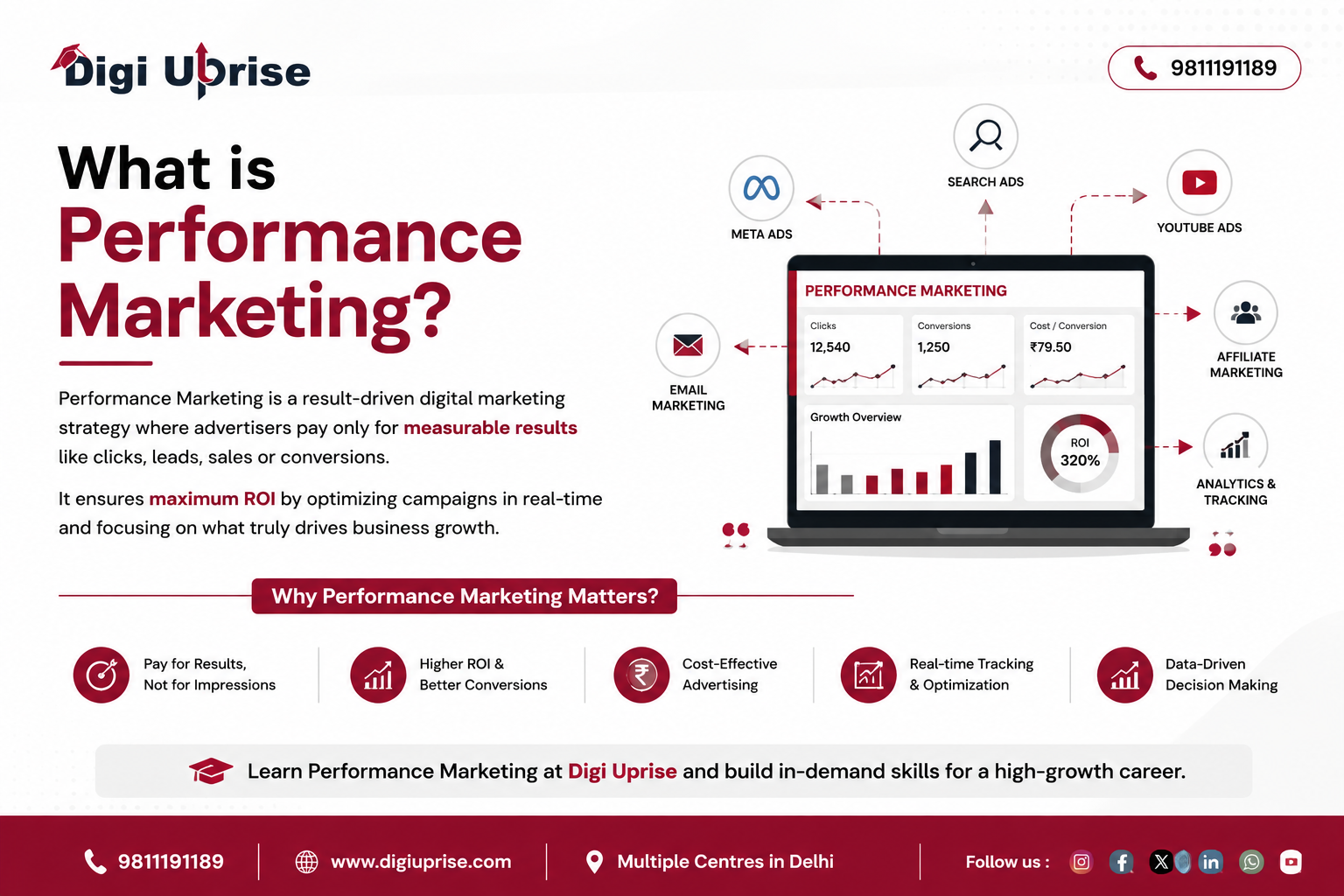
Performance marketing is a form of internet advertising where performance metrics are the determining factors. It is not about how many people view your advertisement; instead, it looks at what happens once the user interacts with the ad campaign.
These actions may include:
- Website visits
- Lead submissions
- Product purchases
- App installations
- Phone calls
- Registrations
- Downloads
The goal is to connect advertising activity with a specific business result.
In simple terms, performance-based marketing asks: Did the campaign produce the action we wanted?
For example, an online education company may spend ₹20,000 on advertising and generate 80 enquiries. By calculating the cost per lead and tracking how many enquiries become customers, the business can understand whether its campaign is profitable.
This makes performance-based marketing particularly useful for businesses that want to make advertising decisions based on data.
How Does Performance Marketing Work?
Performance marketing follows a continuous process rather than a one-time advertising activity. Marketers set a goal, identify an audience, select a channel, launch campaigns, measure results, and optimize based on the data.
1. Set a clear objective
First, businesses decide what they want their campaign to achieve.
Common objectives include:
- Generate leads
- Increase sales
- Get registrations
- Drive app downloads
- Increase calls or enquiries
A specific objective makes it easier to select the right campaign strategy and measurement system.
2. Identify the target audience
The next step is understanding who is most likely to take the desired action.
For example, if an institute that specializes in marketing wants to reach out to someone who wants to learn about marketing techniques, they could target students, job seekers, entrepreneurs, or even professionals.
3. Choose the right channel
There are different performance-based marketing channels for different buyer journeys. The right channels include search advertising and social media advertising.
4. Launch and track
When the campaign is launched, marketers will track metrics such as clicks, conversions, leads, sales, and other important metrics.
5. Optimize continuously
Performance of the campaign may be enhanced through testing of various advertisements, target audiences, keywords, budgets, offers, and landing pages.
This process allows marketers to identify what works and gradually allocate more resources toward stronger-performing campaigns.
Which Performance Marketing Channels Should You Know?
There is no single channel that works for every business. The right option depends on the audience, product, budget, and campaign objective.
Search advertising
Search advertising allows businesses to appear when users search for specific products or services.
For example, someone searching for “digital marketing course in Delhi” may see an advertisement from a training institute. Since the user has already shown interest, the campaign can potentially generate a qualified enquiry.
Social media advertising
Social media platforms allow advertisers to reach people based on interests, demographics, behavior, and previous interactions.
A clothing company, for example, could show a new collection to users who have previously interacted with similar products or visited its website.
Affiliate marketing
Affiliate marketing is the promotion of goods by a publisher or website in exchange for payments based on predefined outcomes.
It is closely linked to performance-based advertising since payments could be associated with some measurable outcomes.
Remarketing
Remarketing focuses on people who have already interacted with a business.
Imagine a customer visits an online store, views a pair of shoes, but leaves without purchasing. A remarketing advertisement can later remind that person about the product.
Which Metrics Measure Performance?
Numbers play an important role in performance marketing. Marketers should know not only how many people were exposed to the advertisement but also what results came from these interactions.
Metric | Meaning | Purpose |
CTR | Click-through rate | Measures how often users click an ad |
CPC | Cost per click | Shows average cost for each click |
CPA | Cost per acquisition | Measures cost of a desired action |
CPL | Cost per lead | Measures the cost of generating a lead |
Conversion Rate | Percentage of users who convert | Evaluates conversion effectiveness |
ROAS | Return on ad spend | Compares revenue with advertising cost |
For example, suppose two campaigns each spend ₹10,000.
Campaign | Leads | Cost Per Lead |
A | 50 | ₹200 |
B | 25 | ₹400 |
Campaign A seems more efficient considering cost per lead. However, if the customers coming from Campaign B spend much more, then that campaign will create more value for the business.
This is why marketers should connect individual metrics with revenue, customer quality, and business objectives.
Performance Marketing vs Branding: What’s the Difference?
The discussion around performance marketing vs branding is not necessarily about choosing one over the other. Both approaches can serve different purposes.
Performance marketing generally focuses on measurable actions, while branding focuses on awareness, recognition, trust, and long-term customer relationships.
| Performance Marketing | Branding |
| Focuses on measurable actions | Focuses on awareness |
| Tracks leads, sales, or conversions | Tracks reach and brand perception |
| Uses data for frequent optimization | Uses creative communication |
| Results are easier to attribute | Results may take longer to measure |
| Often conversion-focused | Often awareness-focused |
A simple example
Consider a new restaurant.
The restaurant could run a branding campaign introducing its name, menu, location, and story to local customers. It could simultaneously run a performance campaign offering ₹200 off and tracking how many customers use the offer.
The branding activity builds familiarity, while the performance campaign measures direct customer response.
Using both approaches can help businesses build recognition while also generating measurable results.
What Are the Benefits and Challenges?
Performance-based marketing can give businesses greater visibility into advertising results. Instead of relying only on assumptions, marketers can use campaign data to make decisions.
Key benefits
- Measurable outcomes: Leads, sales, clicks, and conversion rates can be measured.
- Budget flexibility: Budget can be adjusted according to performance.
- Targeted advertising: Target audiences can be reached by companies.
- Continuous optimization: Campaigns can be improved through testing.
- Scalability: Successful campaigns can receive additional investment.
The above-mentioned advantages make the marketing model beneficial for companies interested in understanding how their advertising helps their growth.
However, performance marketing is not always effective. High competition increases the cost of advertising, while poor targeting and landing pages waste the budget.
Common Beginner Challenges
Beginners often focus too heavily on clicks instead of actual conversions. Other common mistakes include:
- Starting campaigns without installing proper conversion tracking.
- Neglecting the landing page experience.
- Reaching out to overly large audiences.
- Making changes to several components of campaigns without testing.
- Scaling budgets without being aware of their profitability.
Good campaign management requires both technical knowledge and analytical thinking.
How Can Beginners Get Started?
Beginners do not need to master every advertising platform at once. Starting with one channel and one clear objective can make learning easier.
Follow these steps
Step 1: Learn the basics
Learn CPC, CTR, CPA, CPL, conversion rate, bidding, targeting, and ROAS.
Step 2: Choose one platform
Start with a platform that matches your audience and business objective.
Step 3: Define the conversion
Define whether it should be sales, leads, phone calls, registrations, or any other action.
Step 4: Create a relevant landing page
Develop a landing page that is relevant to the ad and tells users what to do after clicking.
Step 5: Set up tracking
Set up conversion tracking before making any substantial budget investments. Reliable data is vital for optimization.
Step 6: Test and improve
Try various creatives, headlines, audiences, offers, and landing pages.
Knowing how to develop successful digital marketing campaigns will also allow beginners to learn how PPC ads complement SEO, social media, content marketing, and email marketing.
Understanding how to measure digital marketing performance also helps marketers move beyond vanity metrics and focus on results that matter to the business.
Conclusion
With performance marketing, advertising is made a quantifiable activity. This means that every rupee that you spend on advertising can be traced to leads, sales, registrations, and enquiries. It is because of this that performance marketing makes an excellent introduction point for people new to digital marketing.
Three steps will enable you to be successful at digital marketing: learn about digital marketing, choose one channel, measure the metrics that count, and then test your campaigns till you achieve success.
Are you ready to learn digital marketing practically? Get help from Digi Uprise to gain practical knowledge about digital marketing through training and campaign experience.
Follow Digi Uprise on Instagram and YouTube for digital marketing advice and other useful information.

Frequently Asked Questions
1. Is performance marketing suitable for beginners?
Yes. Beginners can begin with the basics of advertising, tracking, targeting, and analytics prior to advanced optimization.
2. Do businesses need a website for performance marketing?
No. Some campaigns do not require landing on a traditional website, as they can get calls, messages, app installs, or lead form fills from within the platform itself.
3. How much does performance marketing cost?
There is no fixed cost. Advertising expenses depend on the platform, industry competition, target audience, location, campaign objective, and available budget.
4. What is the difference between performance marketing and affiliate marketing?
Affiliate marketing is just one form of performance marketing, which uses third parties to promote products or services. Performance marketing is a broader term that encompasses such aspects as search advertising, social advertising, retargeting, affiliate marketing, and other measurable campaigns.
5. Can performance marketing increase sales?
Yes, it has the potential to drive sales if a campaign has the proper audience, offer, tracking, creative, and conversion. However, results may vary among businesses and campaigns.