
- September 3, 2026
WhatsApp Marketing 2026: Turn Chats Into Customers | Digi Uprise
Share with Friends :
Table of Contents
What if your everyday chats on WhatsApp could be turned into leads, sales, and loyal customers?
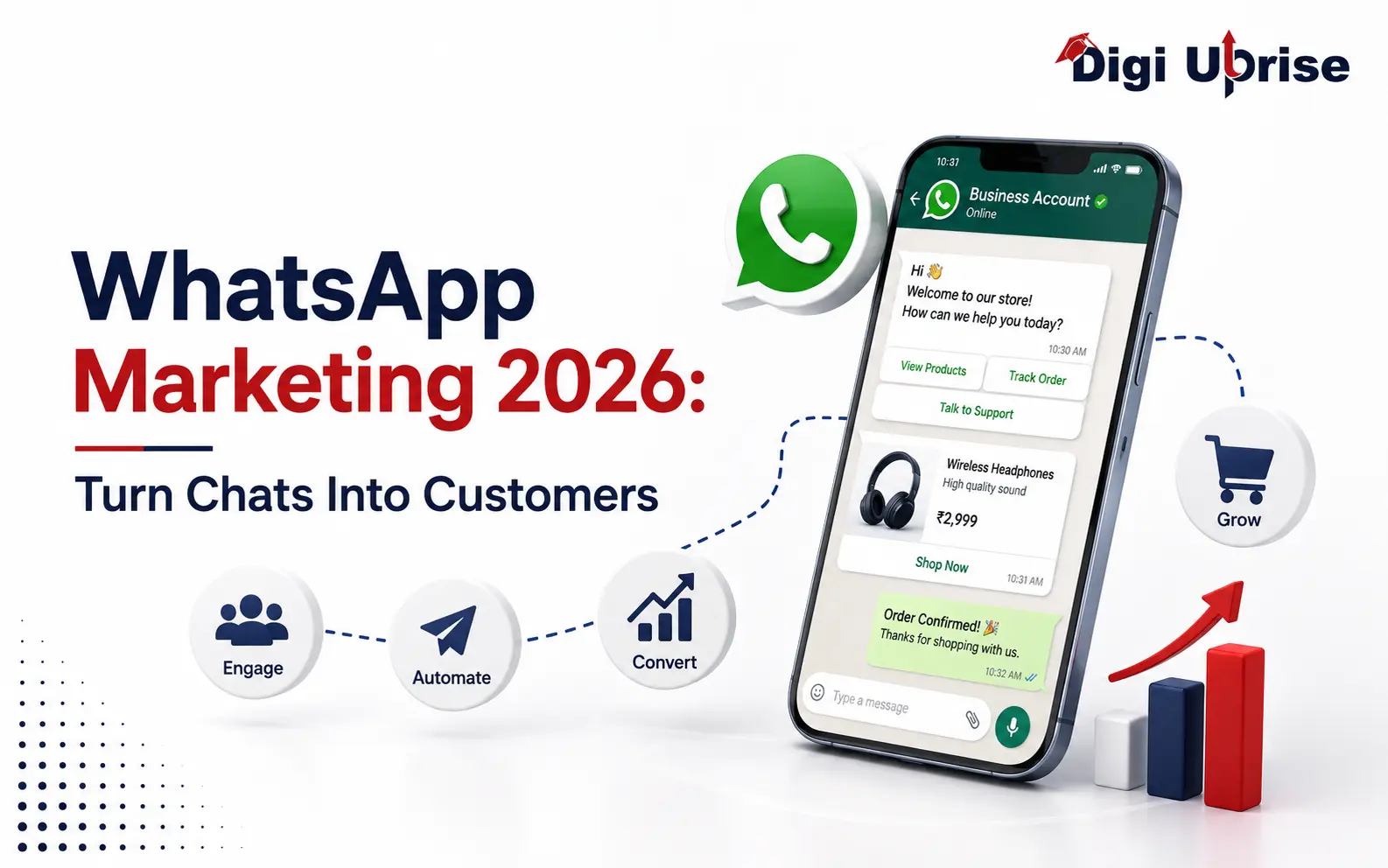
WhatsApp marketing has changed from merely promoting products to helping businesses connect with their customers, answer their queries, nurture leads, and make conversions.
In this guide, Digi Uprise explains WhatsApp Business marketing, the WhatsApp Business API, automation, personalization, and practical ways to turn customer chats into business growth.
What Is WhatsApp Marketing and How Does It Work?
WhatsApp marketing is the use of WhatsApp to communicate with customers, promote products or services, generate leads, provide support, and encourage repeat purchases.
Unlike traditional advertising, WhatsApp creates a two-way communication channel. A customer can ask a question, receive product information, get a recommendation, and move closer to a purchase within the same conversation.
For small businesses, the WhatsApp Business app provides features such as business profiles, catalogs, quick replies, labels, and automated greetings. Growing businesses can use the WhatsApp Business API to connect conversations with CRM systems, chatbots, automation platforms, and customer-service tools.
WhatsApp Business vs WhatsApp Business API
Feature | WhatsApp Business App | WhatsApp Business API |
Best for | Small businesses | Growing businesses |
Communication | Mostly manual | Automated + team-based |
Automation | Basic | Advanced |
CRM integration | Limited | Extensive |
Scalability | Moderate | High |
For example, a local salon can use WhatsApp Business to answer appointment enquiries. In contrast, an e-commerce company can use the API to automate order updates, abandoned-cart reminders, and support.
Selecting the right configuration ensures that businesses don’t make things unnecessarily complicated for themselves, resulting in enhanced user experience.
Conversations can turn into Conversions
Imagine a customer visits an online store, browses a product, and exits without purchasing it. A relevant WhatsApp conversation can bring that customer back by answering questions, sharing details, or reminding them about the purchase.
The same approach works across industries. A coaching institute can follow up with course enquiries, a real estate company can qualify property leads, and a salon can confirm appointments.
This makes WhatsApp Business marketing more than a promotional channel—it can become part of the complete customer journey.
Personalization Creates Engagement
Consider the following two messages:
Basic: “Get 30% off on all products. Shop now!”
Personalized: “Hello Rahul, the running shoes that you checked earlier are now available at 20% off. Would you like to see the available sizes?”
The second message connects with the customer’s previous interest, making it more relevant and conversational.
Businesses can also combine WhatsApp with their wider digital marketing tools, including SEO, paid advertising, social media, and content marketing.
How Can WhatsApp Business Turn Chats Into Customers?
The real value of WhatsApp Business marketing comes from what happens after someone starts a conversation. Businesses should focus on creating useful interactions rather than treating every contact as an immediate sales opportunity.
Build a Permission-Based Audience
Companies can obtain WhatsApp contacts via website sign-up forms, check-out pages, enquiry forms, QR codes, and social media marketing campaigns.
Customers should clearly understand what type of communication they are agreeing to receive. Permission-based communication helps establish trust and reduces unwanted messages.
Segment Customers Before Messaging
Sending the same message to all does not always produce the best outcome. Companies can segment contacts according to:
- New leads
- Existing customers
- Previous purchasers
- Product interests
- Abandoned carts
- Inactive customers
This allows businesses to create more relevant campaigns instead of repeatedly sending generic promotions.
Create Messages People Want to Read
Every message should have a purpose. It could educate, answer a question, provide an update, recommend a product, or solve a customer problem.
For example, an online fashion store could recommend new products based on previous purchases rather than sending the same discount to every contact.
Relevant communication makes WhatsApp marketing feel more useful and less like traditional advertising.
Use Automation Without Losing the Human Touch
Automation can deal with repetitive tasks, such as greetings, FAQs, appointment reminders, notifications of orders, qualifying leads, and customer queries.
Larger organizations can integrate the interactions through the WhatsApp Business API into their CRM and automation software.
Automation should take care of repetitive tasks, while human employees should handle more complicated issues.
Connect WhatsApp With Your Sales Funnel
WhatsApp becomes more effective when connected with other marketing channels.
A customer might discover a business through Google, click a paid advertisement, visit a landing page, and then start a WhatsApp conversation. That conversation can become the bridge between marketing and sales.
Businesses can also explore PPC advertising, landing page optimization, and lead generation strategies to improve the complete customer journey.
Which WhatsApp Marketing Strategies Can Drive Business?
Businesses can use WhatsApp at different stages of the customer journey, from generating leads to supporting existing customers.
Click-to-WhatsApp Campaigns
Click-to-WhatsApp ads encourage people to start a conversation directly from an advertisement.
For example, a digital marketing institute can promote a course and allow potential students to ask about fees, syllabus, timings, or admission dates through WhatsApp.
Instead of making customers search for contact details, the conversation begins immediately.
Personalized Broadcasts
Broadcasts may have several applications, such as launching new products, making season-based offers, updates, and personalizing offers. But relevancy should come before quantity.
For example, a restaurant may send an offer on weekends to those customers who have responded to similar offers earlier.
Abandoned-Cart Follow-Up
E-commerce brands can reconnect with customers who added products to their carts but did not complete their purchase.
“Your chosen pair of sneakers is still sitting in your shopping cart. Go ahead and complete the purchase and get free shipping!”
A simple, timely reminder can bring the customer back into the buying journey.
Lead Nurturing
Not all leads are ready for purchase at once. The use of WhatsApp can help businesses convey information about the product, answer queries, compare products, and follow up at appropriate times.
For example, a student looking for a digital marketing course may inquire about the fee structure. Subsequently, the institution can convey information on the curriculum, career prospects, and other queries to the student.
This makes WhatsApp useful for lead nurturing, not just direct sales.
Customer Updates and Support
WhatsApp can improve the post-purchase experience through order confirmations, delivery updates, appointment reminders, payment notifications, and customer support.
While these transactions will not necessarily result in income, they increase trust and improve the customer experience.
What Is the WhatsApp Business API Used For?
The WhatsApp Business API is meant for businesses that want to handle customer communications on a large scale. It can connect WhatsApp with CRM systems, automation platforms, chatbots, and customer-service software.
Common applications include:
Use case | Benefit |
Lead qualification | Identifies customer needs |
Customer support | Handles common questions |
Order updates | Keeps customers informed |
Appointment reminders | Reduces missed appointments |
Abandoned carts | Reconnects with potential buyers |
CRM integration | Organizes customer information |
Chatbots | Provides instant responses |
For example, an online retailer can connect its order-management system with WhatsApp. Customers can automatically receive order confirmation, shipping updates, and delivery notifications.
The API becomes especially useful when a business has multiple support agents, high message volumes, or complex customer journeys.
How Can You Measure WhatsApp Marketing Success?
Sending messages is only the beginning. Businesses should measure whether conversations are contributing to meaningful results.
Metric | What it shows |
Delivery rate | Messages successfully delivered |
Read rate | Messages viewed |
Response rate | Customers who replied |
Click rate | Link or CTA engagement |
Conversion rate | Customers completing an action |
Revenue | Sales generated |
Opt-out rate | Customers stopping communication |
For example, a campaign may have a high read rate but few conversions. It could mean that your clients are interested in your communication but not convinced about your offer.
Measuring such metrics will help organizations better target, time, and make better offers.
Conclusion
It is not all about sending promotional messages on WhatsApp in 2026. With proper use of personalization, automation, and relevant content, the conversations on WhatsApp can become leads and sales.
Digi Uprise helps learners develop practical digital marketing skills across SEO, social media marketing, Google Ads, performance marketing, and other growth-focused strategies.
Follow Digi Uprise on Instagram and YouTube for digital marketing tips, industry updates, and practical learning resources.
Frequently Asked Questions
1. Is WhatsApp marketing relevant for all companies?
Yes. It can be relevant to both B2B and B2C businesses when the customer requires prompt responses, customized advice, and assistance.
2. Can WhatsApp marketing replace a website?
No. A website is used for discovery and providing details, whereas WhatsApp marketing is more about communication, inquiries, support, and follow-ups.
3. Can businesses sell products through WhatsApp?
Yes. Businesses can use product catalogs and discussions to showcase their products, clarify customer queries, and ultimately help them make purchases.
4. Does WhatsApp Business API work for startups?
Yes, especially when startups are getting more customers and requiring automation or integrations. For now, the WhatsApp Business app might be enough for smaller teams.
5. How does WhatsApp marketing improve customer retention?
WhatsApp could be used for post-purchase customer care, valuable notifications, and personalized re-engagement.