- October 27, 2026
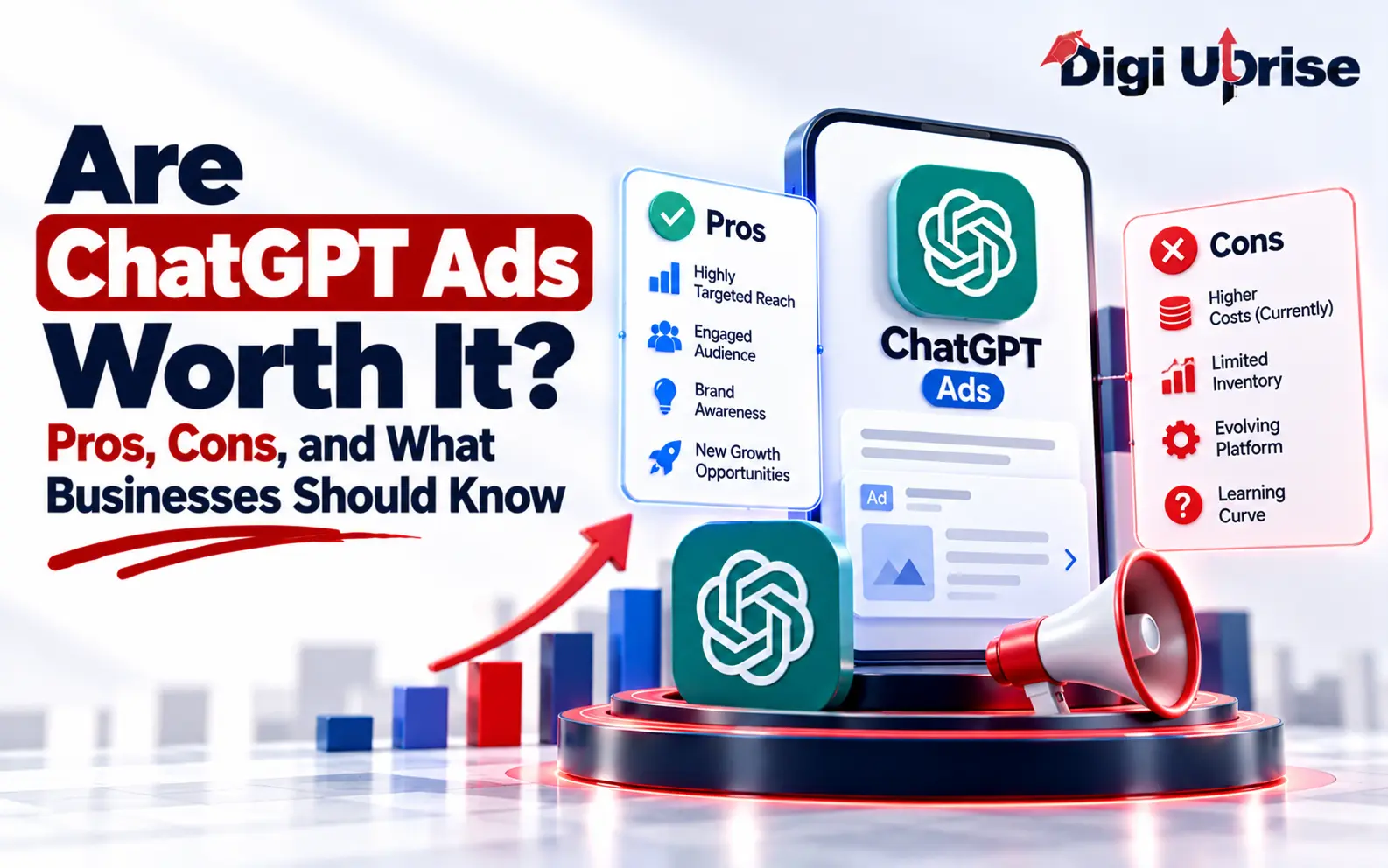
Are ChatGPT Ads Worth It? Pros, Cons, and What Businesses Should Know
Share with Friends :
Table of Contents
- What Are ChatGPT Ads and How Do They Work?
- What Are the Main Benefits of ChatGPT Ads?
- What Are the Pros and Cons of ChatGPT Ads?
- What Are the Disadvantages of ChatGPT Ads?
- ChatGPT Ads vs Google Ads: Which Is Better?
- Is ChatGPT Advertising Effective for Businesses?
- How Should Businesses Decide Whether ChatGPT Ads Are Worth It?
- Conclusion: Are ChatGPT Ads Worth It?
- Frequently Asked Questions
Think about the last time you shopped around for software or a service. You probably opened a pile of tabs, skimmed a few reviews, and got sick of it halfway through. Plenty of people now skip all that and just ask for an AI chat. Advertisers have noticed.
Does that mean you should rush in? Not really. A new channel isn’t worth your money just because everyone’s talking about it. What counts is who you’d reach, what you’d pay, whether they become customers, and whether you can track any of it.
So we’ll go through the good and the bad, put ChatGPT Ads next to Google Ads, and end with a practical way to decide if a small test makes sense.
Quick Answer: ChatGPT Ads can be worth testing if your customers research before they buy. Results depend on audience fit, cost, landing-page quality, and conversions. Start with a small budget, track your cost per customer, and compare it with your current ad channels before scaling.
What Are ChatGPT Ads and How Do They Work?
They’re paid spots inside ChatGPT. When someone is asking questions or weighing up options, an eligible advertiser can appear with a relevant offer. For the current details on ad formats, delivery, and measurement, see OpenAI’s official guide to ChatGPT Ads.
OpenAI’s ad system considers multiple relevance signals, including the context and intent of the current conversation, the ad’s landing page, title, copy, advertiser-provided context hints, and targeting selections. When ad personalization is enabled, select signals from a user’s broader ChatGPT experience may also help determine which ads are relevant. Advertisers do not receive access to users’ private conversations or personal details.
Say a team lead asks about project management tools. A fitting ad gives them one more option to check. It doesn’t mean they’ll click, let alone buy.
You can manage campaigns through OpenAI’s Ads Manager, with self-service access currently available in India. Advertisers must still meet the applicable account, verification and advertising policy requirements. Ad formats, billing options and measurement capabilities may change, so check OpenAI’s official documentation before launching a campaign.
One thing matters a lot: ads and answers are separate. OpenAI says you can’t pay to change what ChatGPT tells people. Without that trust, the ads wouldn’t be worth much either.
What Are the Main Benefits of ChatGPT Ads?
The upside comes from how people use a chat. Don’t read any of it as a guarantee.
You Meet People While They’re Deciding
Search ads rely on a short query, and social ads on what someone’s been scrolling. In a chat, people actually explain themselves. Someone hunting for accounting software might mention their team size, the features they need and a tight budget. If your ad fits, you’ve shown up at a useful moment. Whether it pays off depends on your audience, your setup and the product.
More Context Than a Keyword
A three-word search says very little. A conversation says more, and the system can use eligible signals from it to pick a fitting ad. Just remember that context isn’t intent. A student asking about running shoes for a class project isn’t about to buy a pair.
Something New to Try
If one platform brings in most of your leads, that’s risky. ChatGPT Ads could join search, social, email and organic traffic as another test. For a step-by-step planning approach, read Digi Uprise’s guide to building a ChatGPT Ads strategy. If you’re new to this, Digi Uprise is a good place to learn campaign planning, audience research and measurement. Judge the channel against what you already do, not against the hype.
What Are the Pros and Cons of ChatGPT Ads?
Potential advantages | Potential disadvantages |
An emerging ad environment | Results may swing widely between campaigns |
Contextually relevant placements | Conversion potential is still uncertain |
Another channel to test beside current ones | Extra budget and management time |
Reach during the research stage | Fair comparisons need careful testing |
Chance to build measurement know-how | Features and policies can change |
The biggest plus is reaching people mid-research, which suits anything people think hard about before buying. But the audience has to actually produce something. A well-placed ad that never leads to a sale is just a tidy expense.
Testing costs more than ad spend, too. Someone has to build the campaign, fix the landing page, set up tracking and read the results.
What Are the Disadvantages of ChatGPT Ads?
Be honest about the downsides before you put real money in.
Costs and Returns Are Hard to Predict
A low price per click can fool you. You might pay little for visitors who never buy, while one pricier click from a serious buyer turns out to be a bargain. Check the current billing options, run a small campaign, and trust your own numbers. Don’t assume chat ads will be cheaper or convert better than anything else.
Measuring Results Takes Work
OpenAI provides conversion measurement through Ads Manager using the OpenAI Pixel, the Conversions API, or both, subject to account eligibility and campaign setup. Configure conversion tracking before launch so you can evaluate which clicks lead to enquiries, registrations or purchases. You can also use UTM parameters to track campaign traffic in your analytics platform.
Privacy and Trust
Ads in a chat product naturally raise questions about privacy and how ad relevance is determined. OpenAI states that advertisers do not have access to users’ private conversations, chat history, memories or personal details. Advertisers receive aggregated, non-identifying performance data, such as total views and clicks, rather than private chat content. OpenAI also states that it never sells user data to advertisers. Businesses should review the current advertising and privacy policies before launching campaigns.
ChatGPT Ads vs Google Ads: Which Is Better?
These aren’t quite the same kind of thing, so the answer depends on who you’re trying to reach.
Factor | ChatGPT Ads | Google Ads |
Advertising environment | Conversational AI experience | Search results and other supported placements |
Ad relevance | Conversation context and other eligible signals | Search queries, audience signals and campaign targeting |
User journey | Can reach users exploring options or comparing solutions | Search campaigns can reach users actively searching for products or services |
Measurement | Ads Manager reporting and supported conversion tracking | Google Ads conversion tracking and reporting |
Best approach | Test against defined business goals | Use existing conversion data to guide campaign optimization |
Picture a web design studio. Google Search Ads can catch someone typing “website design company” who’s clearly shopping. ChatGPT Ads might reach people still working out what kind of site they need. Neither is a sure winner; it comes down to your offer, competition, landing page and conversion process.
If you already get decent search traffic and have reliable conversion data, Google Ads is the safer start. You can also read this ChatGPT Ads vs Google Ads comparison for a closer look at how the platforms differ. ChatGPT Ads are worth a trial when you can access the platform and know who you want to reach. Compare cost per customer and lead quality using real data.
Is ChatGPT Advertising Effective for Businesses?
Nobody can give you a flat yes or no. A software firm, a course provider and a local plumber all want different things: demo requests, sign-ups, phone calls. Decide what success means before you launch, then watch the metrics that matter to your business.
Because ChatGPT Ads is still in beta, there are no established performance benchmarks across advertisers, industries, or campaign types. Results can vary with campaign objectives, ad creative, landing-page experience, relevance, and account setup. Use your own campaign data rather than assuming that industry-wide CPC or conversion-rate averages apply.
- Click-through rate: impressions that turn into clicks.
- Conversion rate: visits that end in the action you wanted.
- Cost per acquisition: what it costs to win a customer or defined conversion.
- Return on ad spend: revenue from ads versus what they cost, where attribution is reliable.
- Lead quality: whether enquirers are the people you actually want.
Never read one in isolation. A great click-through rate can sit on a losing campaign, and a cheap lead is no bargain if it never pays. Digi Uprise has useful material on performance marketing and analytics if you’re building these skills. Effectiveness is something you prove with your own results.
How Should Businesses Decide Whether ChatGPT Ads Are Worth It?
Don’t move a big chunk of budget overnight. Run a proper test.
Pick one goal
Leads, sales, sign-ups and awareness are measured differently.
Check eligibility
Review Ads Manager requirements, campaign options and policies.
Think about who’ll see it
Do they really need what you sell? A big audience isn’t always a valuable one.
Set a small budget
Spend what you can afford while you learn.
Fix the landing page and tracking
The offer should be clear and conversions measurable.
Compare with your current channels
Look at lead quality, cost per customer and revenue, not just clicks.
Decide from evidence
Put more in if it works, fix what’s fixable, and stop if it keeps missing.
Digi Uprise is relevant here too, since marketers need to plan campaigns and read data as platforms keep changing. You’re not trying to be everywhere. You’re looking for the few places where the right people see you at a cost you can live with.
Conclusion: Are ChatGPT Ads Worth It?
So, are ChatGPT Ads worth it? It depends, and the pros and cons only make sense together. The channel offers a new way to reach people while they research, but fit comes down to your goals, audience, costs, tracking and results.
With a clear offer, a defined audience and dependable tracking, a small controlled test is probably worth a go. Otherwise, fix your current campaigns first. Nobody can promise results here, and anyone who does is guessing. Spend more only when your numbers back you up.
Frequently Asked Questions
1. Are ChatGPT Ads worth it for small businesses?
Possibly, yes. If the platform lets you advertise in your category, a small test is a fair way to find out. Don’t walk in with a big budget, though. Pick one goal, spend only what you can afford to lose, and make sure tracking works before day one. Then look at how good the leads are and what each customer costs you before putting in more.
2. What are the biggest disadvantages of ChatGPT Ads?
Mostly the unknowns. You can’t be sure how a campaign will perform, measuring it properly takes effort, and the testing costs money. Features and rules can change too, and you’ll need to check you’re eligible and follow the policies. That’s why it makes more sense to test small than to assume it’ll beat whatever already works for you.
3. Are ChatGPT Ads better than Google Ads?
Not really, and it isn’t a fair fight anyway. People on Google are usually searching for something specific. People in ChatGPT are in the middle of a conversation. The easiest way to see what works for you is to run a small campaign next to what you already have, then compare the cost and the quality of the leads.
4. How can businesses measure ChatGPT Ads performance?
Start with the numbers that matter to your business: impressions and clicks first, then conversions, cost per acquisition and return on ad spend. What you can see depends on your account and setup, so sort out your tracking before you launch, not after.
5. Can advertisers pay to influence what ChatGPT says in its answers?
No. OpenAI says ads and answers are kept apart, so paying doesn’t change what ChatGPT says. Ads are clearly labelled as sponsored and are displayed separately from ChatGPT’s answers. They commonly appear below a response, although OpenAI is also testing other formats, including visual ads during image generation.