- October 9, 2026
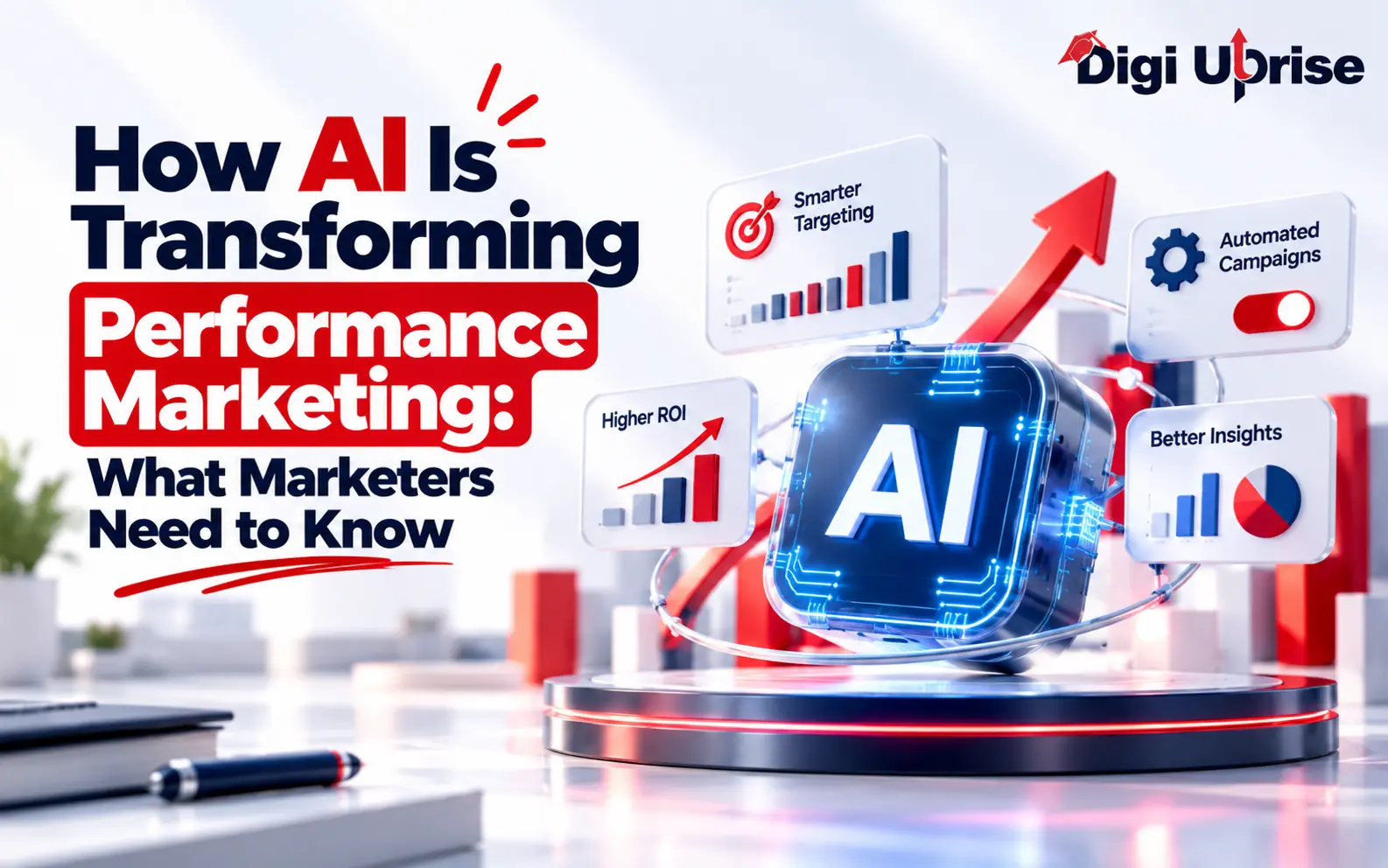
How AI Is Transforming Performance Marketing: What Marketers Need to Know
Share with Friends :
Table of Contents
Anyone who has run paid campaigns for more than a few months knows the feeling. You open the dashboard on Monday, and by Wednesday you’re still trying to work out why last week’s numbers look the way they do. Too many metrics, too many tabs, never enough hours.
That’s why AI’s impact on performance marketing has become such a hot topic. AI can chew through campaign data in seconds, flag things you would have missed, and take over some of the grunt work. But it isn’t magic, and anyone who says it will run your ads on its own is selling something. At Digi Uprise, we think the smart approach is to understand what AI is genuinely good at and where you still have to think for yourself. So let’s get into it.
How AI Is Transforming Performance Marketing
AI is transforming performance marketing by taking the slow, heavy work off marketers’ plates. It speeds up campaign analysis, audience targeting, ad optimization, personalization, and reporting, and it helps the decisions behind them rest on real data. It doesn’t replace the marketer. It handles the repetitive tasks and spots the patterns, so you can put your energy into strategy, creative ideas, and understanding your customers. Put simply, you spend less time wrestling with data and more time deciding what to do with it.
Key Uses of AI in Performance Marketing
1. Why Performance Marketing Needs AI
Performance marketing has always been about proof. Which audience clicked? Which ad converted? Where did the money go, and did it come back with friends?
The trouble is that a single campaign now produces a mountain of data. Every click, scroll, pause, and abandoned cart adds to the pile. A human team can’t read all of it carefully, and pretending otherwise just leads to decisions made on hunches.
This is where AI in performance marketing earns its keep. It can scan huge datasets, notice patterns, and catch shifts in customer behavior long before someone spots them in a weekly report.
AI marketing analytics also goes a bit deeper than normal reporting. A regular report says conversions dropped on Tuesday. Good analytics helps you see why. Maybe a certain audience stopped responding, or a placement got more expensive. That “why” is where the real decisions live.
2. How AI Improves Audience Targeting
For years, targeting meant picking a box: women, 25 to 34, living in a metro city. It worked, sort of. But it treated millions of different people as one group.
AI customer targeting looks at what people actually do. What they browse, what they’ve clicked before, how long they stay, what they keep coming back to. From that, it can separate the person casually window-shopping from the person who is one click away from buying.
Those two people shouldn’t see the same ad. Before, showing them different things took a lot of manual effort. Now it can happen almost on its own.
3. How AI Optimizes Campaign Performance
A lot of us learned this the hard way. You launch a campaign, check it every few days, and by the time you’ve figured out what’s not working, half the budget is gone.
AI for campaign optimization shortens that gap. It watches performance signals continuously and points out opportunities in audiences, creatives, bids, placements, and budget splits while the campaign is still live.
Here’s the part people skip over, though. You can’t just switch it on and walk away. AI doesn’t know that your brand is launching a big sale next week, or that a competitor just slashed prices, or that your client hates a certain tone. Those things need a human. I’d describe AI as a very fast assistant with no common sense about your business. Useful, but it needs supervision.
4. How AI Automates Performance Marketing Tasks
Be honest, how much of your week goes into copying numbers into reports? Checking the same dashboard five times? Sorting data into something presentable?
AI marketing automation can take a big bite out of that. Monitoring, organizing data, spotting patterns, and drafting certain reports all go faster. The time you get back is worth more than the time saved. It lets you spend a few more hours on strategy, creative ideas, and actually understanding your customers, which no tool does for you.
5. How AI Is Changing PPC and Paid Advertising
Paid advertising is where AI has moved in fastest, and you can see it in the platforms themselves. AI-powered advertising helps read campaign signals and run ad operations with fewer manual steps.
Look at AI in PPC advertising. Bidding, audience selection, placements, and optimization are now partly handled by automated systems that weigh thousands of signals at once. No person could do that math by hand during a live auction.
Google Ads Smart Bidding uses AI to optimize bids for conversions or conversion value in each auction, based on the selected bidding strategy. Learn more about Google Ads Smart Bidding.
But this changes what a good PPC marketer does. The old job was mostly keyword research and bid adjustments. The new one is understanding what the platform’s automation is doing, questioning its recommendations, and knowing when to override it. If you don’t understand the basics, you can’t tell whether the machine is helping or quietly burning your budget.
6. How AI Enables Better Marketing Personalization
We all know the feeling of seeing an ad that has nothing to do with us. We also know the slightly unsettling feeling of an ad that knows too much. Good personalization sits somewhere in between: relevant without being weird.
AI-powered personalization uses signals like past visits, browsing habits, engagement, and purchase history to adjust what each person sees. Two visitors can land on the same website, and one gets a beginner’s guide while the other gets a product comparison. Same page, different experience.
The practical win is that nobody has to hand-build a separate journey for every segment. That was never realistic for small teams anyway.
7. How Predictive Analytics Improves Marketing Decisions
Most analytics is about the past. What happened last month, last quarter, last year. Useful, but it’s like driving while only looking in the rear-view mirror.
Predictive analytics in marketing adds a glance at the road ahead. It can estimate how customers might behave, identify high-value audiences, forecast campaign results, and recognize patterns that usually show up before a sale.
Say your data shows that people who watch a product video and then check the pricing page often buy within a week. An AI system can spot more people behaving that way and help you reach them sooner. So instead of only asking “What went wrong last month?”, you start asking “Where should the money go next?” That’s a pretty big shift in mindset.
8. How AI Speeds Up Creative Testing
Performance marketing is not just spreadsheets. A strong headline or a sharp image can change a campaign’s whole result, and that hasn’t changed.
What has changed is the speed of testing. AI can help produce and compare lots of headline, copy, and image variations, then show which ones people respond to. You’re no longer stuck testing two versions for three weeks.
Still, AI can tell you what worked. It struggles to tell you why a joke landed or why a certain tone felt right for your audience. Brand voice, emotion, and cultural context come from people. The best work I’ve seen comes from both sides together.
Benefits and Challenges of AI in Performance Marketing
What Are the Benefits of AI in Performance Marketing?
- Faster analysis: large datasets in minutes instead of days
- Sharper targeting: behavior-based audiences, not just demographics
- Quicker optimization: changes guided by near-real-time signals
- Less repetitive work: routine tasks handled automatically
- Better personalization: experiences that feel more relevant
- More experiments: more creative and campaign variations tested
- Backed-up decisions: strategy supported by real evidence
A fair warning, though. None of this is guaranteed. If your data is messy, your goals are vague, or your campaign setup is sloppy, AI will just help you make mistakes faster.
What Are the Challenges of Using AI in Marketing?
Bad data gives bad insights. That’s the simplest and most common issue. Another trap is getting lazy. When a system keeps making decent suggestions, it’s tempting to stop checking them, and that’s how small problems grow quietly.
Privacy is a big one too. AI-powered marketing depends on customer and behavioral data, so businesses need to handle it carefully and follow whatever rules apply to them.
And then there’s bias. If the data that trains or guides a system carries bias, the recommendations can carry it as well. Someone has to keep an eye out for that, and it won’t be the software.
Comparing AI-Driven and Traditional Performance Marketing
AI vs. Traditional Performance Marketing
Traditional Approach | AI-Driven Approach |
Manual data analysis | Automated data analysis |
Fixed audience segments | Dynamic audience insights |
Manual optimization | AI-assisted optimization |
Historical reporting | Predictive insights |
Slower testing | Faster experimentation |
Reactive decisions | More predictive decision-making |
That doesn’t mean the old ways are dead. Good targeting logic, clear goals, and honest measurement still matter. AI just stretches what you can do with them.
How AI Will Shape the Future of Performance Marketing
The future of performance marketing will probably look like a partnership. Campaigns will get more predictive, more personal, and quicker to react when customer behavior shifts. AI may help with finding audiences, testing creative, forecasting, and analysis.
Marketers will need to grow along with it. Reading data well, thinking strategically, using AI tools, staying creative, and making ethical calls will all matter more. That’s why understanding how AI is transforming performance marketing is useful for veterans and beginners alike. Learning at places like Digi Uprise lets people pick up these new tools without losing the fundamentals underneath them.
Conclusion
AI has changed how marketers work. It affects how we understand audiences, run campaigns, read data, personalize the customer experience, and decide where the budget goes. Still, the story isn’t about machines taking over. The marketers who’ll do well are the ones who pair their own creativity and judgment with what AI does best: crunching data and spotting patterns quickly.
More and more businesses are using AI in their ads, analytics, automation, and customer communication, so knowing how to work with these tools is turning into a basic skill for anyone entering the field. If you’re a student or a working professional wanting to build it, an AI-powered digital marketing course in Delhi can be a good place to start. You learn the core marketing concepts first, then see how AI fits on top of them.
That’s what Digi Uprise is all about. We help you understand where digital marketing is heading and give you skills you can put to work on real campaigns. Learn the fundamentals first, add AI on top, and performance marketing starts to make sense. You can plan it, test it, and get better at it with each campaign.
Frequently Asked Questions
1. How does artificial intelligence improve performance marketing strategies?
Honestly, the biggest help is speed. AI chews through campaign data that would take your team days, flags what’s working, and guesses what’ll work next. Targeting gets tighter, budgets get split smarter, and creative tests wrap up sooner. You still decide, though.
2. What role does AI-driven automation play in performance marketing campaigns?
AI-driven automation reduces manual campaign management by automating tasks such as bid adjustments, audience analysis, performance monitoring, and optimization.
3. Will artificial intelligence replace performance marketing professionals?
AI is more likely to change the role of performance marketers than completely replace them. AI handles numbers and routine tasks well, but it can’t read a client’s mood or take a creative risk. Marketers who learn to work with it will be fine. The ones who ignore it might struggle.
4. How is AI technology used in PPC advertising and paid search?
Modern advertising platforms use AI and machine learning to automate bidding, audience selection, placements, keyword-related recommendations, and conversion predictions, depending on the campaign type and settings. These signals can help platforms determine where and when ads are more likely to perform, depending on the campaign type, settings, and available data.
5. What developments can marketers expect from AI in performance marketing?
Expect more automation and sharper predictions, with campaigns adjusting themselves in real time. Ads will feel more personal too. For marketers, that means reading data, knowing the tools, and still running experiments and thinking creatively. Keep learning and you’ll be fine.
6. Where can beginners learn AI, performance marketing, and digital marketing?
If you’re starting from zero, pick a course with real practice, not just theory. Digi Uprise runs digital marketing programs covering AI, performance marketing, SEO, and social media. You work with tools, which builds confidence faster than reading about them.